When you look at the exterior of a home, your eyes are likely drawn to the architectural details: the pitch of the roof, the texture of the siding, or the color of the front door. Rarely do we stop to admire the horizontal metal channels running along the eaves. Yet, in terms of functional protection, the humble gutter system is one of the most critical components of your home’s envelope.
It is easy to assume that "a gutter is a gutter." To the untrained eye, a flimsy vinyl trough bought at a discount hardware store might look similar to a custom-fabricated aluminum system installed by a professional. However, the difference in performance, longevity, and protection is vast. A low-quality system is essentially a temporary bandage that will eventually fail, leading to wet basements, rotted fascia boards, and eroded landscaping. A high-quality system, on the other hand, is a precision-engineered defense mechanism designed to handle thousands of gallons of water without faltering.
So, what exactly elevates a gutter system from "standard" to "high-quality"? Is it the material? The size? The way it is attached to the house? The answer is "all of the above."
In this comprehensive guide, we will dissect the anatomy of a superior gutter system. We will explore the nuances of material thickness, the science of flow dynamics, and the critical importance of expert craftsmanship. Whether you are building a new home or replacing a failing system, understanding these factors will help you make an investment that truly protects your property.
1. The Foundation: Material Selection and Quality
The first and most obvious indicator of quality is what the gutter is actually made of. While you can find gutters made of vinyl, steel, aluminum, and copper, the grade of these materials varies significantly.
The Problem with Vinyl
At the bottom of the quality spectrum lies vinyl (PVC). While inexpensive and easy for DIYers to snap together, vinyl lacks structural integrity. In cold climates, it becomes brittle and cracks. in hot climates, it warps and bows under UV exposure. A high-quality system avoids standard vinyl because it simply cannot withstand the test of time or the weight of heavy rain and debris.
The Gold Standard: Aluminum
For the vast majority of residential applications, aluminum is the material of choice—but not just any aluminum.
- Rust Resistance: Unlike steel, aluminum does not rust. This is non-negotiable for a high-quality system. A system that rusts is a system that will eventually leak.
- The Gauge Factor: This is the secret spec that separates professional systems from big-box store kits. Aluminum thickness is measured in inches. Standard/Economy: Often .025 inches thick. This is flimsy and easily dented by a wayward ladder or a falling branch.
- High-Quality: The industry standard for premium residential installation is .027 or preferably .032 inches. This "heavy gauge" aluminum is rigid, robust, and capable of holding the weight of snow, ice, and wet leaves without buckling. When you hire Cola City Roofing , we prioritize materials that can stand up to the elements.
The Luxury Tier: Copper and Galvalume
For those seeking the ultimate in durability and aesthetic, copper represents the pinnacle of quality.
- Copper: A copper system is a lifetime investment. It never needs painting, it doesn’t rust, and it develops a protective patina over time. It is soldered at the joints, creating a bond stronger than the metal itself.
- Galvalume: This is steel coated in an aluminum-zinc alloy. It offers the extreme strength of steel with the corrosion resistance of aluminum, often used in modern or industrial-style homes.
2. Construction: Seamless vs. Sectional
If you take only one thing away from this guide, let it be this: A high-quality gutter system must be seamless.
The Flaw of Sectional Gutters
Traditional sectional gutters come in 10-foot pieces. To cover a 50-foot roofline, you would need five sections joined together by connectors and sealed with caulk.
- Leak Points: Every seam is a potential leak. Over time, UV rays degrade the sealant, and thermal expansion pulls the seams apart.
- Debris Traps: The ridges inside the gutter where sections connect act as speed bumps for water and traps for pine needles, leading to clogs.
The Seamless Advantage
A high-quality system is manufactured on-site using a specialized machine. The contractor feeds a continuous coil of metal into the machine, which forms the gutter to the exact length of your roof.
- Zero Seams: On a 50-foot run, there are zero seams. The only connection points are at the corners (miters) and end caps.
- Structural Integrity: A continuous piece of metal is structurally stronger than several pieces pieced together.
- Aesthetics: The clean, uninterrupted line of a seamless gutter looks significantly better and enhances curb appeal.
When you invest in our gutter installation services , you are investing in custom-fabricated, seamless protection.
3. Capacity: Size Matters
A gutter system can be made of the strongest metal on earth, but if it is too small to handle the volume of water coming off your roof, it is a low-quality system for your specific home.
The Standard 5-Inch vs. The High-Performance 6-Inch
For decades, the 5-inch K-style gutter was the residential standard. However, as weather patterns shift and storms become more intense, the 5-inch gutter is often overwhelmed.
- Capacity: A 6-inch gutter holds approximately 40% more water than a 5-inch gutter.
- Overshoot Protection: On homes with steep roof pitches, rainwater accelerates as it runs down the shingles. A narrow 5-inch gutter can be "overshot," meaning the water flies right over the edge. The wider opening of a 6-inch gutter captures this high-velocity runoff effectively.
A high-quality assessment involves calculating the square footage of the roof and the steepness of the pitch to determine the necessary capacity. Installing a 5-inch gutter on a large, steep roof is a sign of cutting corners. Upgrading to 6-inch gutters prevents the "waterfall effect" that damages foundations.
Downspout Sizing
The gutter trough is only half the equation; the water must have a way out. Standard systems use 2×3 inch downspouts. High-quality systems often upgrade to 3×4 inch downspouts .
- Flow Rate: The larger downspout allows water to evacuate the gutter much faster during a deluge.
- Clog Prevention: The wider opening allows small debris like helicopter seeds and roof grit to flush through the system rather than creating a bottleneck at the outlet.
4. The Hardware: Hidden Hangers vs. Spikes
How the gutter attaches to your home is a critical determinant of its lifespan. In the past, installers used "spikes and ferrules"—large nails driven through the front of the gutter into the fascia board.
The Failure of Spikes
- Thermal Movement: Metal expands and contracts with temperature changes. Over time, this movement works the smooth nail loose from the wood.
- Sagging: As the spike pulls out, the gutter sags. Water pools in the low spot, adding weight and pulling the spike out further. It is a vicious cycle of failure.
- Ugly Aesthetics: The nail heads are visible on the face of the gutter and often rust, leaving unsightly streaks.
The Quality Solution: Hidden Hangers
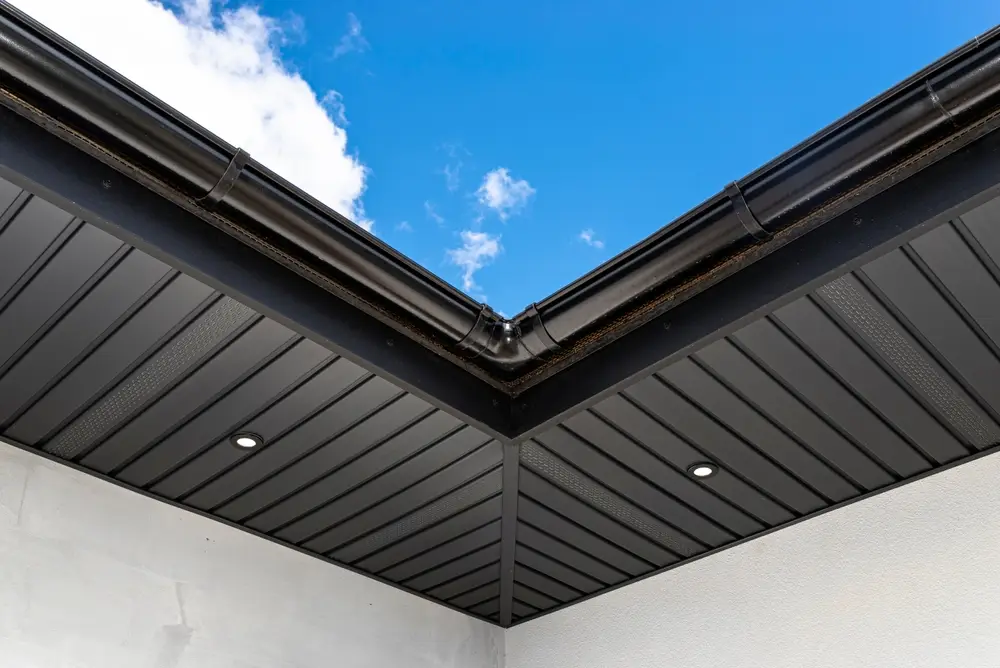
A modern, high-quality system uses hidden hangers . These are brackets that clip inside the gutter and are invisible from the ground.
- Screw Strength: Instead of a smooth nail, hidden hangers are secured with heavy-duty screws. The threads bite into the fascia board and hold tight, resisting thermal movement.
- Support: High-quality hangers are designed to support significant weight. In areas prone to snow and ice, or heavy wet leaves, this strength prevents the gutter from tearing off the house.
- Spacing: Quality isn’t just about the hanger itself, but how many are used. A "budget" installation might space hangers every 3 or 4 feet. A high-quality installation places a hanger every 24 inches (or even closer in snow zones) to ensure continuous support along the entire run.
5. The Science of Slope (Pitch)
You might think gutters are hung perfectly level, parallel to the roofline. If they were, they wouldn’t work. For water to flow toward the downspout, the gutter must have a slight, imperceptible slope.
The "Goldilocks" Pitch
- Too Little Slope: Water sits in the gutter. Standing water breeds mosquitoes, causes odors, and accelerates corrosion.
- Too Much Slope: The gutter looks crooked on the house, ruining the aesthetic appeal.
- Just Right: A high-quality installation achieves a pitch of roughly 1/4 inch for every 10 feet of run. This is enough to keep water moving and self-cleaning, but subtle enough that the gutter line looks straight to the naked eye.
Achieving this requires professional levels and experience. It is one of the main reasons DIY installations often fail. If you notice water standing in your gutters days after a rainstorm, the pitch is incorrect, and you may need gutter repair services to re-hang the system properly.
6. Corner Construction: Box Miters vs. Hand-Cut Strip Miters
The corners of a house are the weakest points in a gutter system. This is where water changes direction, causing turbulence and potential splashing.
Box Miters (The Easy Way)
Many installers use "box miters," which are pre-fabricated corner pieces that the straight gutter sections slide into. While fast to install, they create two seams at every corner (one on each side of the box) and look bulky.
Strip Miters (The Quality Way)
A high-quality installation typically uses "strip miters" or hand-tabbed corners.
- Custom Fit: The installer cuts the two joining gutter sections at a 45-degree angle so they meet perfectly.
- Single Seam: A thin strip of aluminum is installed over the single seam on the outside (or inside), sealed with high-grade architectural sealant.
- Sleek Look: This results in a sharp, tight corner that looks much cleaner and has fewer potential failure points than a box miter.
7. Sealants: The Unsung Hero
The best metal in the world is useless if the sealant at the end caps and corners fails.
Consumer-Grade Caulk
Low-quality installations often use generic silicone or latex caulks found at hardware stores. These sealants are not designed for the extreme expansion and contraction cycles of metal gutters. They dry out, crack, and shrink within a year or two, leading to drips.
Professional-Grade Geocel or equivalent
High-quality systems use specialized gutter sealants (often based on tri-polymer technology).
- Adhesion: These sealants adhere aggressively to aluminum, even if it is slightly damp or oily during installation.
- Elasticity: They remain flexible permanently. When the metal gutter expands in the summer sun and shrinks in the winter freeze, the sealant stretches and compresses without breaking the bond.
- UV Resistance: They are formulated to withstand direct sunlight without degrading.
When evaluating a gutter quote, ask what type of sealant is used. It is a small detail that makes a massive difference in leak prevention.
8. Protective Finishes: Paint That Lasts
Aluminum doesn’t rust, but raw aluminum is silver. Most homeowners want gutters that match their trim or siding.
Field Painting vs. Factory Finish
Painting gutters by hand after installation is a sign of a low-quality job. The paint will inevitably peel and flake within a few years.
High-quality gutters come with a factory-baked enamel finish .
- Durability: The manufacturing process involves cleaning the metal, applying a primer, and then baking on the finish coat at high temperatures. This creates a bond that is virtually indestructible.
- Warranty: These finishes often come with 20-year or even 50-year warranties against chipping, peeling, or blistering.
- Color Range: Quality suppliers offer dozens of colors, allowing for perfect matching to your home’s palette. Whether you want the gutters to disappear into the fascia or stand out as an architectural accent (like black or dark bronze), a factory finish ensures they stay looking new for decades.
9. Flashing and Drip Edge Integration
A high-quality gutter system does not exist in isolation; it must integrate with the roof system.
The Drip Edge Connection
The drip edge is a metal flashing that sits under the roof shingles and hangs over the edge of the roof.
- Poor Installation: The gutter is hung too low or too far forward, leaving a gap between the drip edge and the back of the gutter. Water drips between the gutter and the fascia board, rotting the wood behind the gutter.
- High-Quality Installation: The gutter is tucked firmly up behind the drip edge (where possible) or flashing is installed to bridge the gap. This ensures that 100% of the water running off the roof goes into the gutter, not behind it.
Protecting the fascia board is just as important as moving the water. If the fascia rots, the screws holding the gutter will fail, and the system will fall.
10. Debris Management: The Role of Guards
While a gutter itself can be high quality, its performance is compromised the moment it clogs. In neighborhoods with mature trees, a high-quality system usually includes some form of protection.
Screens vs. Advanced Filtration
- Basic Screens: Simple metal mesh can keep out large leaves, but they often trap debris on top, requiring you to climb a ladder to sweep them off.
- High-Quality Micro-Mesh: Premium guards use stainless steel micro-mesh. The holes are so small that only water can pass through, while pine needles, shingle grit, and pollen are kept out. The best designs are pitched so that wind blows the dry debris off the top.
Including a high-performance guard transforms the system from "low maintenance" to "virtually no maintenance," which is a hallmark of quality.
11. Strategic Downspout Placement
The design phase is where expertise truly shines. A novice might place downspouts wherever it is easiest. A professional designs the system for optimal hydrology and aesthetics.
- Volume Balancing: A high-quality design ensures there are enough downspouts to handle the roof’s water volume. A long 60-foot run with only one downspout is a recipe for overflow.
- Water Diversion: Downspouts should not dump water right at the corner of the foundation. Quality systems include extensions or splash blocks that carry water at least 4 to 6 feet away from the home. Alternatively, they can be piped into underground drains.
- Aesthetic Concealment: Professionals try to place downspouts on the sides of the house or blend them with corner trim, rather than running them down the middle of a prominent front wall.
12. The Importance of Professional Warranty
Finally, the guarantee behind the work defines its quality.
- Material Warranty: This covers the paint finish and the metal itself (usually 20+ years).
- Workmanship Warranty: This is the critical piece. It covers the installation. If a corner leaks, or the pitch is off, or an end cap pops loose, does the company come back to fix it?
A "tail-light warranty" (good until the contractor’s tail lights disappear down the street) is common in the low-end market. A high-quality system comes with a written workmanship warranty from a reputable company like Cola City Roofing , giving you peace of mind that your investment is protected.
Why "Good Enough" isn’t Good Enough
You might be wondering, "Do I really need heavy-gauge aluminum and micro-mesh guards? Can’t I get by with the cheaper stuff?"
It helps to think about the cost of failure.
- Foundation Repair: Can cost tens of thousands of dollars.
- Mold Remediation: Can cost thousands and impact your health.
- Siding/Fascia Replacement: An expensive carpentry project.
A cheap gutter system might save you a few hundred dollars upfront, but if it fails to protect your foundation or rots your fascia, it becomes the most expensive system you ever bought. A high-quality system is an insurance policy for the structural integrity of your home.
Summary: The High-Quality Checklist
To recap, if you are shopping for a gutter system, here is your checklist for quality:
- Material: .032 gauge aluminum (or copper).
- Construction: Seamless, formed on-site.
- Size: 6-inch troughs for better capacity (unless roof is very small).
- Hardware: Heavy-duty hidden hangers spaced 24 inches or closer.
- Fasteners: Screws, not spikes.
- Sealant: Professional-grade tri-polymer or geocel.
- Pitch: Calibrated for flow, not just eyeballed.
- Installation: Tucked behind drip edge to protect fascia.
- Finish: Factory-baked enamel with warranty.
- Company: Licensed, insured, and warranty-backed.
Conclusion
A high-quality gutter system is a marriage of superior materials and expert craftsmanship. It is a system that you don’t have to think about. It works silently during the heaviest thunderstorms, guiding water safely away from your home, preserving your landscaping, and keeping your basement dry.
Don’t settle for a system that looks okay today but fails tomorrow. Invest in the longevity of your home. If you are ready to upgrade to a system that meets every standard of quality we’ve discussed, we are here to help.
At Cola City Roofing , we specialize in fabricating and installing premium seamless gutter systems tailored to the specific needs of your home. Whether you need a full replacement or are looking to upgrade your current protection, our team delivers the expertise you deserve.
Visit us at colacityroofing.com to learn more, or head directly to our contact us page to schedule a free consultation and estimate. Let’s protect your home with the quality it deserves.
Detailed Breakdown: Why Gauge Thickness is Critical
To understand why .032 gauge aluminum is superior to the standard .027 or .025 gauge often sold at DIY stores, we need to look at the physics of ice and ladders.
The Ladder Test
Homeowners and contractors alike will eventually need to lean a ladder against the house—to paint, to check the roof, or to hang Christmas lights.
- Thin Gauge (.025): When a ladder rests against a thin-gauge gutter, the metal often crinkles or dents. Once a gutter is dented, the flow of water is disrupted, and the structural integrity is compromised.
- Thick Gauge (.032): This commercial-grade thickness is rigid enough to withstand the weight of a ladder without deforming. It maintains its shape, ensuring the profile remains crisp and the water channel remains open.
The Ice Load
In winter, snow and ice can accumulate in the gutter trough. Water weighs roughly 8 pounds per gallon. Ice is heavy.
- Thin Gauge: Under the weight of a heavy snow load, thin aluminum can buckle, warp, or even tear away from the hangers.
- Thick Gauge: The thicker metal acts as a structural beam. Combined with closely spaced hangers, it can support hundreds of pounds of frozen precipitation without failing.
Investing in the heavier gauge upfront eliminates the need for repairs down the road caused by everyday wear and tear.
The Role of End Caps in System Integrity
Often overlooked, the end caps (the pieces that close off the ends of the gutter run) are a tell-tale sign of quality.
- Crimped-On Caps: Low-quality installers simply crimp the end cap onto the gutter and smear some caulk on the inside. These are prone to popping off as the metal expands.
- Riveted and Sealed Caps: A high-quality installation involves mechanically fastening the end cap with rivets and sealing it. The rivet provides a permanent mechanical bond that friction crimping cannot match.
It is these small details—the rivets, the screws, the specific type of sealant—that cumulatively create a "high-quality" system.
Splash Blocks and Underground Drains
A high-quality gutter system doesn’t stop at the bottom of the downspout. The water must be managed after it leaves the pipe.
The "Negative Grade" Problem
Many homes have soil that slopes slightly toward the foundation. If a downspout dumps water right at the base of the wall, that water will run back toward the house, defeating the purpose of the gutter.
Quality Solutions
- Hinged Extensions: These allow you to flip the extension up for mowing the lawn, but keep it down during rain to guide water 4-6 feet away.
- Splash Blocks: Heavy concrete or decorative resin blocks that disperse the energy of the falling water and prevent it from digging a hole in the ground (erosion).
- Underground Piping: The ultimate in quality is piping the downspouts into rigid PVC pipes buried underground, which carry the water to a pop-up emitter in the yard or a storm drain. This keeps the water completely away from the foundation and eliminates unsightly pipes on the lawn.
High-Quality Gutters and Resale Value
Finally, it is worth noting that a high-quality gutter system adds to the resale value of your home.
Home inspectors are trained to look for water damage. A sagging, rusted, or undersized gutter system is a red flag that suggests the home may have hidden moisture issues. Conversely, a crisp, seamless, heavy-gauge system tells a prospective buyer that the home has been well-maintained.
- Curb Appeal: The seamless look and fresh paint finish sharpen the visual lines of the house.
- Inspection Pass: A functional, professional system removes a potential negotiation point during the sale. Buyers won’t need to ask for a credit to replace the gutters.
When you view your gutter system not as a cost, but as an asset that protects and enhances your property value, the decision to choose high-quality components becomes the only logical choice.
A Note on Maintenance for High-Quality Systems
Even the best car needs an oil change, and even the best gutter system needs a check-up. However, a high-quality system makes maintenance significantly easier.
- Self-Cleaning: Because of the proper pitch and smooth seamless interior, high-quality gutters flush out most small debris on their own.
- Durability: You can clean them (or have them cleaned) without worrying about denting them or pulling them off the house.
- Reduced Frequency: If you opt for premium guards, "maintenance" might simply mean brushing off the tops of the guards once a year rather than digging wet muck out of the trough.
For those who prefer to leave the ladder work to the pros, our gutter repair services include maintenance and cleaning to keep your high-quality system performing at its peak year after year.
Your home is your sanctuary. It deserves a defense system that is built to last. Choose quality. Choose durability. Choose protection.