When you look at your home from the street, your gutters probably look perfectly straight. In fact, if they are doing their job correctly, they should look straight to the naked eye. We often judge a gutter installation by how level and clean the lines appear against the roofline. But here is the secret that most homeowners don’t know: if your gutters are actually perfectly level, they are failing.
Gutters are not just storage containers for rain; they are a transportation system. Their entire purpose is to move water from point A (your roof) to point B (the downspout) and eventually to point C (away from your foundation). Since gutters don’t have pumps or motors, they rely entirely on one force to do this work: gravity.
At Cola City Roofing, we often find that when a gutter system fails—leaking, overflowing, or sagging—the issue isn’t a clog or a hole. It’s simple physics. The pitch, or slope, of the gutter is wrong.
Getting this slope right is a game of millimeters. It requires a balance between mechanics and aesthetics. If it is too steep, your house looks broken. If it is too flat, the water goes nowhere.
Why Gutter Slope Matters More Than Most Homeowners Think
It is easy to underestimate the importance of slope because, frankly, it is invisible. When you look at a newly installed gutter system, you are looking at the color, the finish, and how well it matches the trim. You aren’t standing on a ladder with a digital level checking the pitch.
However, the slope is the heartbeat of the system. Without it, the water that lands in the trough is just dead weight. In Columbia, where a summer afternoon storm can dump thousands of gallons of water on a roof in under an hour, that "dead weight" becomes a serious structural threat.
We often see homeowners trying to troubleshoot gutter issues by cleaning them obsessively or adding splash guards, not realizing that the water simply has no motivation to move. They assume that because the gutter is open, the water will find its way out. But water is lazy. It takes the path of least resistance. If the gutter is flat, the path of least resistance is to sit still.
If the slope is off, the water sits. Standing water is the enemy of your home. It creates weight stress on the fascia board, it breeds mosquitoes, and it accelerates corrosion. The slope is the only thing standing between a functioning drainage system and a stagnant moat attached to your roof.
How Water Flow in Gutters Actually Works
To understand slope, you have to understand fluid dynamics—at least the basics of it. Water has weight and surface tension. When it enters a gutter, it needs enough momentum to overcome the friction of the gutter material and the minor obstacles (like shingle grit or small twigs) in its path.
The standard rule of thumb in the industry is that a gutter should slope about one-quarter of an inch for every 10 feet of length. That doesn’t sound like much. On a 40-foot run of gutter, that’s only a one-inch drop from one end to the other. But that subtle incline is enough to generate flow.
The Role of Velocity The goal isn’t just to get the water to the downspout; it is to get it there quickly . During a heavy downpour, your roof is shedding water at a high rate. The gutter needs to evacuate that water as fast as it comes in. If the slope is correct, the water gains velocity as it travels. This speed helps "scour" the gutter, picking up small debris like pollen, dust, and shingle granules and washing them down the drain. This self-cleaning action is a key benefit of proper slope.
Overcoming Surface Tension Water likes to stick to surfaces. If a gutter is perfectly flat, small pools will form due to surface tension and imperfections in the metal. Slope uses gravity to break that tension, pulling the water into a cohesive stream that moves toward the outlet. Without that pull, the water stagnates, and the system fails to perform its primary duty.
What Happens When Gutters Are Too Flat or Too Steep
Achieving the perfect pitch is a "Goldilocks" scenario. You can go wrong in two directions, and both have negative consequences for your home.
The Problem with Flat Gutters (No Pitch)
This is the most common installation error we see, especially with DIY jobs or handyman specials. It makes intuitive sense to hang the gutter level with the roofline, but it is structurally wrong.
- Ponding Water: This is the immediate result. Water sits in low spots.
- Debris Accumulation: Without a current to wash it away, every leaf and pine needle that lands in the gutter stays there. This leads to sludge buildup that turns into compost.
- Mosquito Breeding: In the humid Midlands heat, a gutter holding half an inch of standing water is the perfect nursery for mosquitoes. If you have a bug problem you can’t solve, check your gutters.
- Premature Rust and Rot: Even aluminum gutters can suffer if organic matter rots inside them constantly. But the bigger risk is to the wood fascia behind the gutter. Standing water keeps the system heavy and damp, which eventually transfers moisture to the wood.
The Problem with Steep Gutters (Excessive Pitch)
On the flip side, some installers overcompensate. They think, "If some slope is good, more slope is better!" This creates its own set of issues.
- Aesthetic Failure: A gutter that drops 4 or 5 inches over a short run looks like it is falling off the house. It clashes with the horizontal lines of your siding and roof, reducing curb appeal.
- Overshooting: If water moves too fast, it can hit the end cap or the turn at a corner with too much force, splashing out or overshooting the downspout opening entirely.
- Capacity Reduction: Believe it or not, a steep slope effectively reduces the holding capacity of the gutter because the water rushes to one end so quickly that it can overwhelm the downspout outlet, causing localized overflowing while the rest of the gutter is empty.
Common Gutter Slope Mistakes We See on Homes
In our line of work, we inspect hundreds of homes across Lexington, Irmo, and Columbia every year. We see the same slope-related mistakes repeated over and over. Most of these aren’t malicious; they are just the result of inexperience or a lack of attention to detail.
- The "Follow the Roof" Mistake Many people assume the roofline itself is level. They install the gutter at a constant distance from the shingles. The problem is, houses settle. A roofline on a 1960s ranch home might sag in the middle or dip at one corner. If you follow a crooked roof, you get a crooked gutter. We often see gutters that actually slope away from the downspout because the installer followed a settling roofline rather than using a level.
- The Long Run Error On a long house—say, a 60-foot continuous eave—you cannot just slope the gutter all one way. A quarter-inch drop per 10 feet means a 1.5-inch drop over 60 feet. That might look noticeable and awkward. The correct approach is often to create a "high point" in the center and slope down toward downspouts at both ends. We frequently see 50-foot runs trying to drain into a single downspout, resulting in a slope that is either too flat to work or too steep to look good.
- Improper Hanger Spacing You can set the slope perfectly during installation, but if you don’t support the gutter properly, gravity will ruin it. If hangers are spaced too far apart (more than 24 inches), the metal trough will sag in the middle under the weight of water. These sags create "bellies"—low spots that hold water even if the ends of the gutter are pitched correctly. We see this constantly on homes where installers tried to save money on hardware.
How Improper Slope Leads to Water Damage
We talk about water damage a lot because it is the single biggest threat to your home’s value. Improper gutter slope is a silent contributor to this damage. It’s insidious because it happens slowly.
The "Spillover" Effect When a gutter has no slope, it fills up like a bathtub. Once it reaches the brim, water spills over the front and back edges.
- Front spills erode your landscaping and can crack concrete driveways or walkways.
- Back spills are more dangerous. Water runs behind the gutter, soaking the fascia board, the soffit, and potentially running down the inside of your siding. This leads to hidden rot that you might not discover for years.
The Heavy Load Risk Water weighs over 8 pounds per gallon. A 40-foot gutter with poor slope that is holding standing water can easily carry hundreds of pounds of unnecessary weight. This constant load pulls the fasteners out of the wood. Eventually, the gutter pulls away from the house, leaving a gap. Rainwater then bypasses the gutter entirely, falling straight onto your foundation.
Foundation Issues This is the most expensive consequence. When gutters fail to move water to the corners of the house (the downspouts), that water pools right next to the foundation wall. In the clay-heavy soil of the Midlands, this causes the ground to swell and then shrink, putting immense pressure on your foundation. Over time, this leads to cracks, settling, and wet basements or crawl spaces.
Why Downspout Placement Works Together With Gutter Slope
You cannot talk about slope without talking about the exit strategy. The slope dictates where the water goes, so you must have a downspout waiting there to catch it.
Proper system design starts with locating the best spots for downspouts, and then calculating the slope backwards from there.
The "High Point" Concept On many homes, the aesthetic choice is to have downspouts on the corners, hidden as much as possible. This means the center of the gutter run needs to be the "high point." The gutter slopes down from the middle toward the left corner and down toward the right corner. This effectively splits the water volume in half. Instead of one downspout handling 50 feet of roof water, two downspouts handle 25 feet each. This makes the slope calculations much gentler. You only need enough drop for 25 feet, which is much less noticeable to the eye than the drop needed for 50 feet.
Mid-Run Downspouts Sometimes, due to the design of the house or the volume of water, we need a downspout in the middle of a run. In this case, the gutter slopes toward the center from both ends. This is often necessary on very large roofs, but it requires careful planning to ensure the downspout doesn’t become an eyesore.
If the downspout placement is wrong—for example, if a downspout is placed at the "high" end of a settling foundation—it becomes impossible to slope the gutter correctly without it looking ridiculous. Professional planning ensures the downspouts are in the right places to allow for a subtle, effective slope.
How Roofline and Home Design Affect Gutter Slope
Every house in Columbia presents a different geometry puzzle. The style of your home dictates how we calculate and implement the slope.
The "Hip" Roof Challenge Hip roofs (where the roof slopes down on all four sides) create a continuous gutter line that wraps around the entire house. This requires careful corner management. We have to maintain the slope through the corner. If the slope flattens out at the miter (the corner joint), water will pool there. Since corners are the most likely spots to leak, pooling water there is a recipe for disaster. We have to pitch the gutters so the water keeps moving around the bend.
Complex Fascia Boards Some historic homes in downtown Columbia or Shandon have slanted or decorative fascia boards. Installing a gutter on a slanted board requires special wedges to keep the gutter opening level while maintaining the longitudinal slope. If this isn’t done right, the gutter will tilt forward or backward, affecting how deep the water can get before it spills.
Long Ranch Homes We have many beautiful, sprawling ranch-style homes in Forest Acres and Lexington. These homes often have extremely long horizontal rooflines. Managing slope over a 100-foot run is difficult. It usually requires multiple high points and multiple downspouts to avoid having one end of the gutter mounted five inches lower than the other. It’s a balancing act of capacity versus aesthetics.
Can You Fix Gutter Slope Without Replacing the System?
This is a question we hear often: "My gutters are in good shape, they just don’t drain. Do I have to buy new ones?"
The honest answer is: Maybe.
When You CAN Re-Pitch: If your gutters are relatively new, made of durable aluminum, and are not bent or damaged, we can often re-hang them. This involves:
- Removing the existing hangers or spikes.
- Snapping a new chalk line to establish the correct slope.
- Re-installing the gutters using new, stronger hidden hangers.
- Sealing the old holes in the fascia to prevent rot.
When You CANNOT Re-Pitch:
- Spike-and-Ferrule Systems: If your old gutters are held on with big spikes, pulling them out usually destroys the structural integrity of the gutter back and leaves massive holes in the fascia. It is rarely worth trying to save these.
- Sectional Gutters: If you have vinyl or sectional aluminum gutters that are glued or caulked at the seams, trying to move them usually breaks the seals. They will leak profusely if you disturb them.
- Damaged Metal: If the gutter has sagged for years, the metal may be permanently warped. You can hang it straight, but the "belly" will remain, and water will still pool.
- Rotten Fascia: If the poor slope has caused the fascia board to rot, we have to take the gutters down to replace the wood anyway. At that point, reinstalling old, stained, or bent gutters usually doesn’t make financial sense compared to installing a fresh seamless system.
Why Professional Installation Gets Gutter Slope Right
You might be thinking, "I can own a level. I can do this." And while we respect the DIY spirit, gutter slope is deceptively difficult to get right working from a ladder.
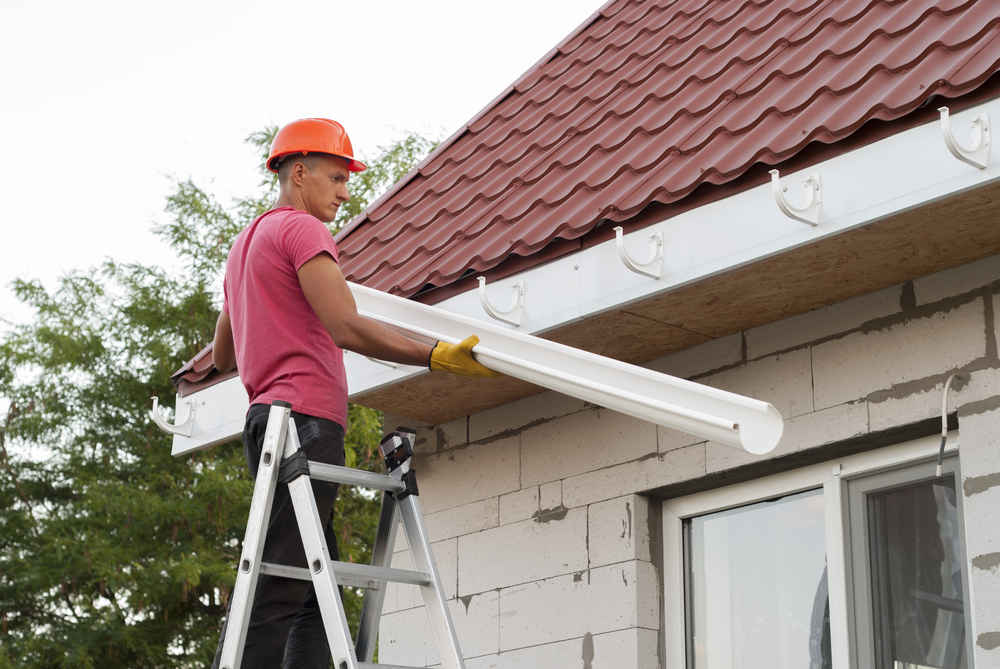
The Perspective Problem When you are on a ladder, you are too close to the work to see the overall line. You might make a section level, move the ladder, make the next section level, and end up with a zigzag pattern. Professionals work from the ground first. We measure the total drop needed, mark the high and low points, and snap a chalk line across the entire length of the fascia. This creates a visible guide that ensures a perfectly straight, consistent slope from end to end.
The Seamless Advantage It is infinitely easier to slope a seamless gutter than a sectional one. A seamless gutter is a single rigid beam. If you lift one end, the whole thing moves. This makes fine-tuning the pitch much more precise. With sectional gutters, every joint is a hinge point that can sag or kink, ruining the smooth flow of water.
The "Water Test" A true professional doesn’t just hang the gutter and leave. We test it. We often run water through the system to ensure it flows rapidly to the downspout and that no puddles remain. We check that the water drains completely dry. This verification step is what separates a "hanger" from a "water management pro."
Keeping Water Moving Where It Should
At the end of the day, your gutter system is a machine powered by gravity. If the geometry is wrong, the machine is broken. It doesn’t matter how expensive the materials are or how good the leaf guards are—if the slope is off, your home is at risk.
Proper gutter slope is the silent hero of a dry home. It keeps water moving swiftly away from your roof, your fascia, and your foundation. It prevents the stagnant pools that breed pests and rust. And when done right, it does all this while looking perfectly aligned with your home.
At Cola City Roofing, we take the science of slope seriously. We don’t guess, and we don’t eyeball it. We measure, we calculate, and we verify. Whether you need a simple re-pitch of an existing system or a brand-new seamless installation designed for maximum flow, we have the tools and the experience to get the physics right.
If you suspect your gutters are holding water, or if you see that tell-tale overflow during a storm, give us a call. We’ll come out, put a level on it, and tell you exactly what’s going on—and how to get things moving again.