In South Carolina, we don’t get the kind of winters they see in the Northeast. We aren’t digging our cars out of four feet of snow every morning. But that doesn’t mean our winters are gentle on your home. In fact, the Midlands weather patterns—where we might have a 70-degree day followed by a freezing night—can be deceptively tough on your exterior systems.
Your gutters are right on the front lines of this seasonal shift. While we often think of summer thunderstorms as the main event for water management, winter brings a different, quieter set of challenges. Cold snaps, freezing rain, and the constant cycle of wet-and-dry can stress your gutter system in ways that aren’t always obvious until something breaks.
At Cola City Roofing, we’ve seen plenty of winter damage that could have been prevented with a little bit of knowledge. Winter gutter issues tend to be sneaky. They happen slowly over weeks of cold nights, only revealing themselves when you see a leak in the spring or notice a piece of trim rotting away.
Why Winter Weather Is Hard on Gutter Systems
You might wonder why winter is such a concern if we don’t get heavy snow. The answer lies in the physics of materials and the behavior of water.
Metal expands and contracts with temperature changes. Aluminum gutters are constantly moving as the thermometer dips below freezing at night and climbs back up during the sunny afternoons. Over time, this movement can work fasteners loose or stress the sealant at the joints (if you have sectional gutters).
But the bigger enemy is the weight. Water is heavy, weighing over eight pounds per gallon. When that water freezes, it expands. If your gutters are holding water because of a clog or poor slope, that water turns into a solid block of ice when the temperature drops. That ice block is not only heavy; it is rigid. It puts immense strain on the hangers and the fascia board.
In the Midlands, we also deal with a lot of organic debris in late fall and early winter. Pine needles, oak leaves, and twigs are often still falling or blowing around just as the freezing temperatures arrive. This combination of debris and cold is the perfect recipe for clogs that harden and stick, making them much harder to clear than the loose, dry leaves of October.
How Ice and Standing Water Create Gutter Issues
The core of most winter gutter problems is simply water that stops moving. Gutters are designed for flow, not storage. When water sits still, it causes trouble.
In the summer, standing water is a mosquito breeding ground. In the winter, it’s a structural hazard. When water freezes inside a gutter, it expands by about 9%. If a gutter is full to the brim with water and debris, that expansion pushes outward against the metal walls of the trough. This can warp the gutter, distorting its shape so that it never flows correctly again, even after the ice melts.
Furthermore, ice doesn’t just sit there; it grips. It grabs onto the shingles, the drip edge, and the rough surface of the gutter interior. As the temperature fluctuates, that ice shifts, potentially lifting shingles or pulling the gutter out of alignment.
This is why we emphasize slope so much. If your gutters are pitched correctly, water drains away before it has a chance to freeze. But if there are low spots or clogs, you are essentially creating ice trays attached to your roofline.
Ice Buildup That Pulls Gutters Away From the House
One of the most dramatic failures we see in winter is gutters physically pulling away from the home. This usually looks like a gap opening up between the gutter and the roofline, or the gutter tilting forward dangerously.
This happens because of weight overload. Your gutter hangers (the brackets that hold the gutter to the house) are rated to hold a significant amount of weight—plenty for a heavy rainstorm. But they aren’t designed to support hundreds of pounds of solid ice for days on end.
When a gutter is clogged and fills with water that subsequently freezes, the weight is static—it just hangs there, pulling constantly on the screws or spikes. If the fascia board behind the gutter is even slightly softened by age or previous water damage, the fasteners will start to slide out.
Once the gutter pulls away even a fraction of an inch, the problem accelerates. Now, water from the roof doesn’t fall into the gutter; it falls behind it. This creates a waterfall effect against your siding and foundation, completely bypassing the drainage system you paid for. In severe cases, we have seen entire runs of gutter rip loose and fall to the ground under the weight of winter ice.
Blocked Gutters That Freeze and Overflow
A blockage in winter is different from a blockage in summer. In warm weather, water might eventually seep through a pile of leaves. In winter, that wet pile of leaves freezes into a solid dam.
When it rains or when snow on the roof melts, that water runs down to the gutter. If it hits a frozen dam of debris, it has nowhere to go. It backs up and immediately overflows.
The "Ice Dam" Effect While true ice dams (thick ridges of solid ice at the eaves) are more common up north, we do see versions of them here in Columbia during cold snaps. If your gutters are blocked, the trapped water freezes at the edge of the roof. As more water runs down, it hits that ice block and backs up under the shingles.
When this water refreezes, it lifts the shingles. When it melts again (from the heat of your attic), it leaks directly into your roof decking. This is how a clogged gutter in January leads to a ceiling stain in your living room.
Furthermore, overflow in winter creates slippery, dangerous conditions on the ground. Water spilling over a clogged gutter will land on your walkway or driveway and freeze into a sheet of black ice, creating a serious fall hazard for you and your family.
Damage to Fascia, Soffits, and Roof Edges
The fascia board is the unsung hero of your roofline. It holds your gutters up and seals the edge of your roof. But it is usually made of wood, and wood hates standing moisture.
In winter, the freeze-thaw cycle accelerates wood rot. If your gutters are clogged and water is trapped against the fascia, that wood absorbs the moisture. When the temperature drops, the water inside the wood fibers freezes and expands, breaking down the cellular structure of the wood.
When it thaws, the wood is softer and more porous, ready to absorb even more water next time. This process turns solid lumber into something with the consistency of a sponge.
The soffit (the underside of the eave) is also at risk. If water overflows the back of the gutter, it runs along the soffit. This can cause paint to peel, wood to rot, and even allow water to enter the attic space through soffit vents. Repairing rotten fascia and soffit is labor-intensive and expensive—often costing much more than the gutter maintenance that would have prevented it.
How Winter Gutter Problems Lead to Interior Water Damage
It’s easy to compartmentalize home repairs: gutters are an "outside problem," and leaks are an "inside problem." But in winter, the two are directly connected.
We mentioned how ice dams can force water up under shingles. Once water bypasses the shingles, it hits the underlayment and the roof deck (the plywood sheets that form your roof). If this exposure is prolonged, the water will find a seam in the plywood or a nail hole.
From there, gravity takes over. The water drips onto your attic insulation. Wet insulation loses its R-value (its ability to insulate), which creates a cold spot on your ceiling. Eventually, the water saturates the drywall ceiling below, leading to bubbling paint, brown rings, or even a collapse of the drywall sections.
We also see interior damage in basements and crawl spaces during winter. If gutters are overflowing and dumping water right at the foundation, and the ground is frozen or saturated, that water will find its way through cracks in the foundation wall. Winter is a common time for crawl space moisture levels to spike because the natural evaporation from the sun is weaker, so the ground stays wet longer.
Signs Your Gutters Are Struggling During Cold Weather
You don’t need to be a roofing expert to spot these issues. Your house will usually tell you if something is wrong. Here is what to look for on a cold morning:
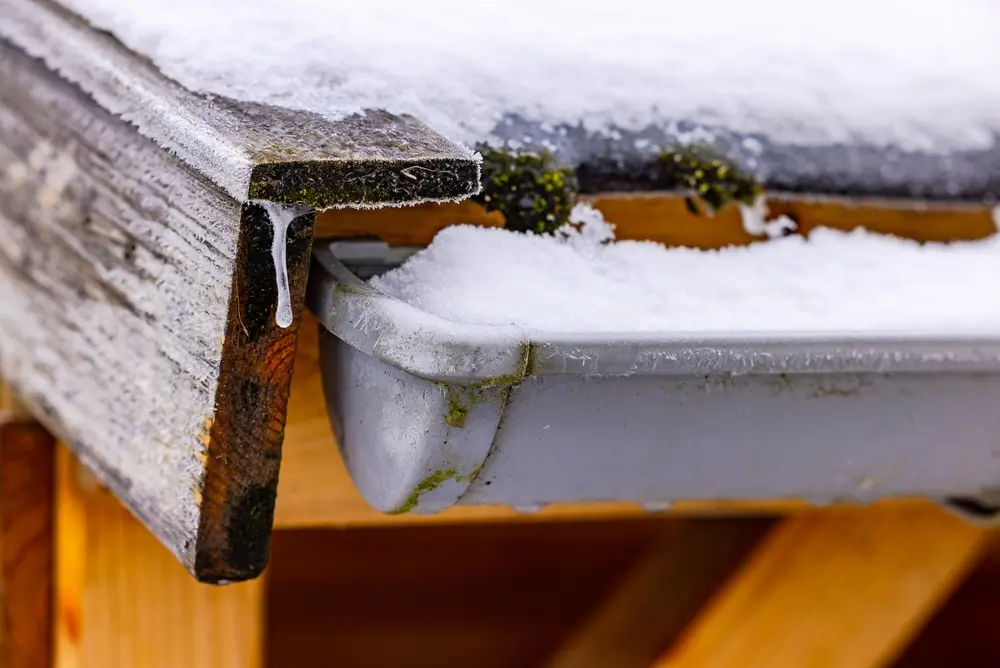
- Icicles: A few small icicles are normal. But if you see large, heavy icicles hanging from the edge of the gutter or, worse, from the soffit behind the gutter, that is a sign of a blockage or improper drainage.
- Ice Sheets on the Ground: If you have a specific patch of driveway or walkway that is always icy, look straight up. You likely have a gutter overflowing directly onto that spot.
- Visible Sagging: Look at the straight line of your gutter. Does it dip in the middle? Does it look like it’s smiling? That sag indicates it is carrying too much weight.
- Gap Behind the Gutter: If you can see daylight between the back of the gutter and the wood fascia board, the fasteners are failing.
- Water Marks on Siding: Look for dark streaks or water stains on your siding underneath the gutters. This means water is escaping the system.
- Piles of Debris: If you can see leaves piling up over the edge of the gutter from the ground, you can be sure the inside is packed solid.
Steps Homeowners Can Take Before Temperatures Drop
The best defense against winter gutter damage is preparation. You want to go into the cold season with a "clean slate."
- The Late Fall Clean-Out: This is non-negotiable. Once the majority of leaves have fallen (usually by late November or early December in Columbia), you need to get the gutters cleaned. Every leaf left in the gutter is a potential anchor for ice.
- Flush the Downspouts: Don’t just scoop the troughs; make sure the downspouts are clear. Use a garden hose to run water down them. If the water backs up, you have a clog that needs to be snaked out before it freezes.
- Check the Spikes/Hangers: While you (or your pro) are up there, check the stability. If a spike is loose, drive it back in. If a hanger is broken, replace it. Strengthening the system now helps it survive the weight of winter.
- Trim Overhanging Branches: If you have tree limbs hanging directly over your roof, winter winds can snap them, dropping them right onto your gutters. Trimming them back protects your roof and your drainage system.
- Inspect the Ground Drainage: Make sure your downspouts are directing water at least 4-6 feet away from the foundation. Add extensions if necessary to keep that winter melt away from your basement.
When Winter Damage Means Repairs or Replacement
Sometimes, despite our best efforts, winter wins. If you discover damage, you need to decide between a repair and a replacement.
Repairable Issues:
- Loose Hangers: If the gutter is straight but just pulling loose, we can often install new, heavy-duty hidden hangers to re-secure it.
- Minor Leaks: Small leaks at seams or end caps can usually be sealed with a high-quality gutter sealant.
- Single Damaged Section: If a falling branch crushed one section of a seamless gutter run, we might be able to replace just that section, though matching the color can sometimes be tricky as old gutters fade.
Replacement Indicators:
- Severe Sagging: If the metal is permanently warped or bent from ice weight, it will never drain properly again. It needs to be replaced.
- Rotted Fascia: If the fascia board is soft and rotting, we have to take the gutters down to replace the wood. Putting old, bent gutters back on new wood usually isn’t cost-effective.
- Widespread Corrosion: If standing water and winter debris have caused rust holes throughout the system, patching is a losing battle.
- Wrong Size: If your gutters consistently overflow every winter despite being clean, they might be too small (5-inch vs. 6-inch) for your roof’s water volume.
Preventing Winter Gutter Damage Year After Year
Winter doesn’t have to be a season of worry for your home’s exterior. The problems we’ve discussed—ice dams, sagging gutters, rotted wood—are almost entirely preventable with a proactive approach.
It starts with changing how we view our gutters. They aren’t just a trim piece; they are a functional machine that protects your home. Like any machine, they need maintenance to run in cold weather.
Taking the time to ensure your gutters are clean, tight, and flowing freely before the first freeze is one of the smartest investments you can make. It protects your foundation, your roof, and your wallet from the hidden costs of water damage.
At Cola City Roofing, we know the specific challenges of Columbia winters. We know how to secure gutters so they hold fast during freezing nights, and we know how to spot the early warning signs of fascia rot. Whether you need a pre-winter inspection, a repair for storm damage, or a completely new system designed to handle heavy loads, we are here to help.
Don’t wait until you see an icicle hanging from your soffit. Give us a call, and let’s make sure your home is ready for whatever the season brings.