In South Carolina, a roofer working for a homeowner must be registered with the Residential Builders Commission once the job tops $500. Below that, state registration isn't required. The threshold comes from the definition of a residential specialty contractor in S.C. Code §40-59-20(7), and it was $200 until May 16, 2022.
Here is what that line means for small repairs, for handymen who take roof work, and for you as the person paying. For the step-by-step lookup itself, see our guide to checking a roofer's registration.
What the law actually says
The statute covers an independent contractor hired by a builder, a general contractor or "individual property owner" for skilled trade work, "when the undertakings exceed five hundred dollars" (§40-59-20(7)). Roofers are one of the trades the statute lists.
LLR's own lookup repeats the line in plain terms. A registrant whose status is PENDING or LAPSED "cannot do work over $500.00" (RBC lookup status notes).
How is the $500 counted?
The statute says "undertakings," and it doesn't spell out the arithmetic. Compare the bond rule two sections later, which is explicit: it applies "when the total cost of materials and labor" exceeds $5,000 (§40-59-240(D)). The $500 definition has no matching phrase.
For an ordinary roof repair, materials and labor are billed together, so the question rarely matters. If your job sits near the line, or if parts of the work are billed separately, call the Commission at (803) 896-4696 and ask before work starts.
One job, several small invoices
The definition speaks of the undertaking, not of each bill. A roofer who offers to split one repair into several invoices under $500 is giving you a reason to ask why. Ask the Commission how it would view the arrangement before you agree to it.
Small repairs under $500
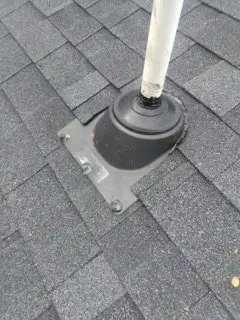
Replacing a few blown-off shingles or a cracked pipe boot can come in under the threshold. For those jobs, the state doesn't require a registration. That doesn't mean nothing applies.
- Local business licenses still apply. The City of Columbia requires a business license of "every person engaged or intending to engage in any business" within city limits (City of Columbia Business License FAQ). It also treats a self-employed worker paid on a 1099 as needing a license of their own.
- Permits are a local question. Whether a small repair needs a permit depends on your city or county office, not on the $500 line. Our roof permits guide covers each Midlands office.
- Complaints may be harder. The Commission's complaint form says each complaint is first reviewed to see whether it falls within the Commission's statutory authority. Work that never required registration may fall outside it. Call (803) 896-4696 to ask.
Get the price on a written estimate before work begins. Small repairs have a way of growing once shingles come off. If the revised price climbs past $500, the job is now over the line, and the person doing it needs a registration.
A small job is also where you meet the roofer you might hire later for a bigger one. Asking for a registration number on a minor repair costs nothing.
Handymen who take roof work
Chapter 59 has no separate "handyman" credential. A handyman who contracts for roofing over $500 is doing residential specialty contracting and needs a registration that includes the roofer classification (§40-59-20(7)).
- Three trades at most. A specialty registration can cover no more than three classifications. Someone who wants more must be examined and licensed as a residential builder (§40-59-240(A)).
- No subcontracting around it. A specialty contractor may not work outside the scope of their registration, "including employing, hiring, and contracting or subcontracting with others" to do that work (§40-59-20(7)).
- No structural work alone. LLR's specialty registrant FAQ says a registrant can't do structural work unless a licensed builder or general contractor supervises it. Rotted rafters are a different job from rotted shingles.
- A bond above $5,000. For an individual owner, a registrant must file a surety bond once materials and labor together exceed $5,000 (§40-59-240(D)). LLR's FAQ puts the bond at $5,000.
So when a handyman says they "do roofs too," look them up on the RBC lookup and check that roofer appears among their classifications.
Why the threshold changed in 2022
The change came from H.3606, which became 2022 Act No. 186. The General Assembly passed it on April 26, 2022, and the Governor signed it on May 16, 2022, the date it took effect.
The act did two things. First, it added a section listing small owner projects that need no permit and no license, such as fences, short decks and finish work (§40-59-265). Second, it rewrote the specialty contractor definition. According to the Code's note on the amendment, it:
- substituted "five hundred dollars" for "two hundred dollars";
- deleted the words "who is not a licensed residential builder";
- added a sentence barring specialty contractors from building additions without a builder's supervision;
- added solar panel installers to the list of specialty trades.
The act's text doesn't state a reason for the higher figure. Its title describes the change only as revising the definition of residential specialty contractors. What it did in practice is simple: small jobs between $200 and $500 no longer require a state registration.
Older articles that still quote $200 are describing the law before May 2022 (bill history).
Why the line matters to you
Above $500, registration is more than paperwork. Unregistered work is a misdemeanor. The penalty is a fine between $500 and $10,000, a jail term of 30 days or more, or both (§40-59-30(A)). An unregistered contractor who needed a registration also "may not file a mechanics' lien" or sue to enforce the contract (§40-59-30(B)).
Doing the work yourself is different. An owner can act as their own builder on a home for their own use (§40-59-260). But that exemption doesn't let you hire an unregistered roofer, and roofing isn't on the 2022 list of owner projects that skip the permit.
For larger roof jobs, the same checks apply plus a few more: board orders, insurance and workers' comp. The full verification guide walks through them.