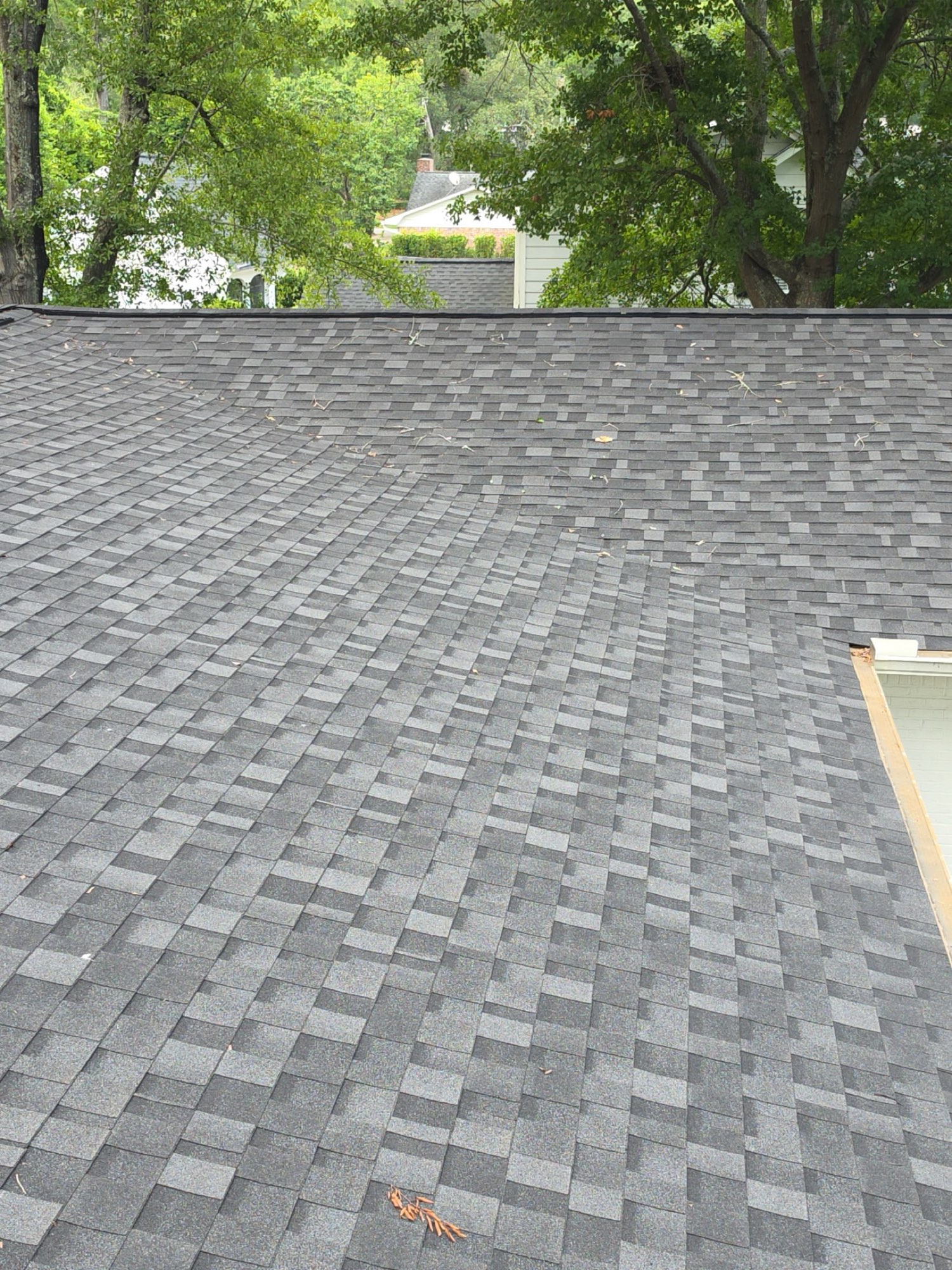
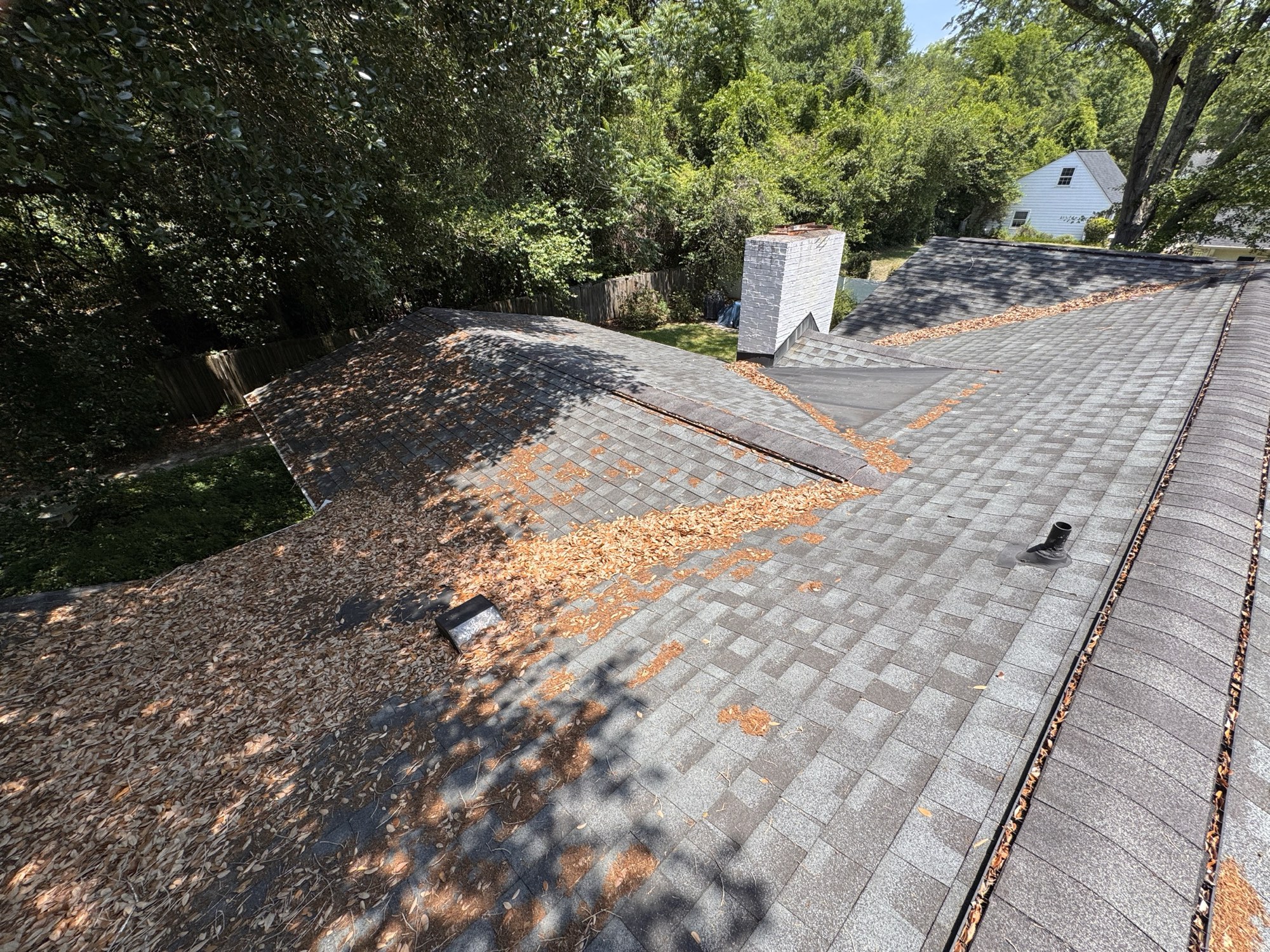
Trees are a big part of why Camden's older neighborhoods look the way they do, and they are also one of the hardest things on a roof here. Shade keeps the shingles damp, leaves and pine straw pile up in the valleys and gutters, and limbs rub, drop or fall. None of that means the trees have to go. It means a shaded roof needs more attention than one in full sun.
This page covers what shade and debris do to a roof, what our own Camden job showed, a maintenance routine, and how to plan tree work around a re-roof. It is part of our Camden roofing page.
What shade does to a roof
A roof in full sun dries quickly after rain and dew. A slope under a dense canopy can stay damp for much of the day, especially on the north side. That steady moisture lets moss, lichen and algae take hold. Algae mostly shows as dark streaks and is largely cosmetic, but moss is different: it holds water against the shingles, lifts their edges as it grows and traps more debris. Over time, a shaded slope often wears out before the sunny slope on the same house.
Leaves and pine straw in valleys and gutters
Valleys collect water from two slopes and are the natural landing spot for leaves, needles and twigs. Once debris builds up, water slows, spreads sideways and works under shingle edges. Gutters packed with debris overflow at the eaves, soaking the fascia and the roof edge, and the wet mat sits against the lowest course of shingles. Pine straw is especially good at knitting into a dense layer that does not wash out on its own.
What our Camden job showed
Our Camden roof replacement is a good example of what years of shade and debris can do. The house is a white brick ranch with a low-pitched, wide roofline, shaded by mature hardwoods that kept it damp year-round. Here is what the photos show:
- Before: the aging shingle roof buried in leaves and pine straw, with debris packed into the valleys and along the gutter line, holding moisture against the shingles.
- Inspection: moss and organic growth taking hold on the worn shingles, with "ROT" and "LEAK" chalked over soft decking and an active leak path.
- Inside: water staining spreading across the bathroom ceiling around the exhaust fan.
- Tear-off: rot at the chimney base and rotted decking that had to be cut out before new sheathing and charcoal architectural shingles went on.
Not all of that damage came from the trees. Tear-off also found two failed chimney crickets, a second layer of old shingles and worn flashing. But a roof that stays wet and covered in debris gives every weak spot more water to work with. See roof replacement in Camden for the full job.
Limbs: rubbing, dropping and falling
Branches that touch the roof scrub the granules off shingles every time the wind moves them, and they give squirrels a path onto the roof. Dead limbs drop in ordinary wind. In storms, whole trees come down: after Helene in September 2024, the National Weather Service reported many trees and power lines down across Kershaw County and a few structures damaged by falling trees. A certified arborist can tell you which trees and limbs are a real risk. For what to do after a limb hits, see storm and tree damage to Camden roofs.
A maintenance routine for a shaded Camden roof
There is no single right schedule, because it depends on what is overhead. A reasonable starting point:
- Look at the roof and gutters from the ground at least twice a year, typically in spring and again after the leaves drop in late fall.
- Under pines or heavy hardwoods, clear gutters more often. Many owners need to do it several times a year.
- Check valleys and the area behind the chimney for buildup after every major storm or windy stretch.
- Watch for moss, lifted shingle edges and dark wet patches on shaded slopes.
- Keep limbs trimmed back from the roof surface.
- Look at ceilings and the attic after heavy rain, especially under valleys and around the chimney.
Stay off a wet or mossy roof
Moss, algae and wet leaves make shingles slippery. Clearing a roof is safer done by someone with fall protection. Pressure washing can strip granules and force water under shingles, so avoid it on asphalt shingles.
Gutters and gutter guards
Gutters that work keep water off the fascia and away from the foundation. Under trees, gutter guards can cut down how often gutters need clearing, but no guard is maintenance-free, and pine needles can sit on top of some screen types. Our post on gutter guards for homes with trees and the gutter guards guide compare the options. If your gutters are sagging or rotted, see gutter repair or gutter installation.
Moss and algae cleaning
Moss and algae can be cleaned off with a low-pressure soft wash that kills the growth without blasting the shingle surface. Cleaning makes sense on a roof with life left in it. On a roof that is already worn out, cleaning will not bring it back. See our roof softwash cleaning service.
Tree work before a re-roof
If you are planning a new roof, deal with the trees first. Pruning or removing limbs over a new roof risks damaging it, and debris from tree work lands on the shingles you just paid for. Plan the order this way:
- Have an arborist or tree service assess the trees over and near the house.
- Do any pruning or removal and haul off the debris.
- Then schedule the roof, with a plan for where the dumpster goes and how beds and shrubs under the eaves will be protected.
We did not find a City of Camden rule on removing trees on private lots, but trees near the street may be on public right-of-way. Call the city at 803-432-2421 before removing a large tree near the street or sidewalk, and check any neighborhood or HOA rules that apply to your lot.
Get a shaded Camden roof checked
Cola City Roofing inspects roofs across Camden and Kershaw County, including from the attic, and tells you what the trees are doing to yours. Contact us or call (803) 734-3700. For general upkeep, see the roof maintenance guide.