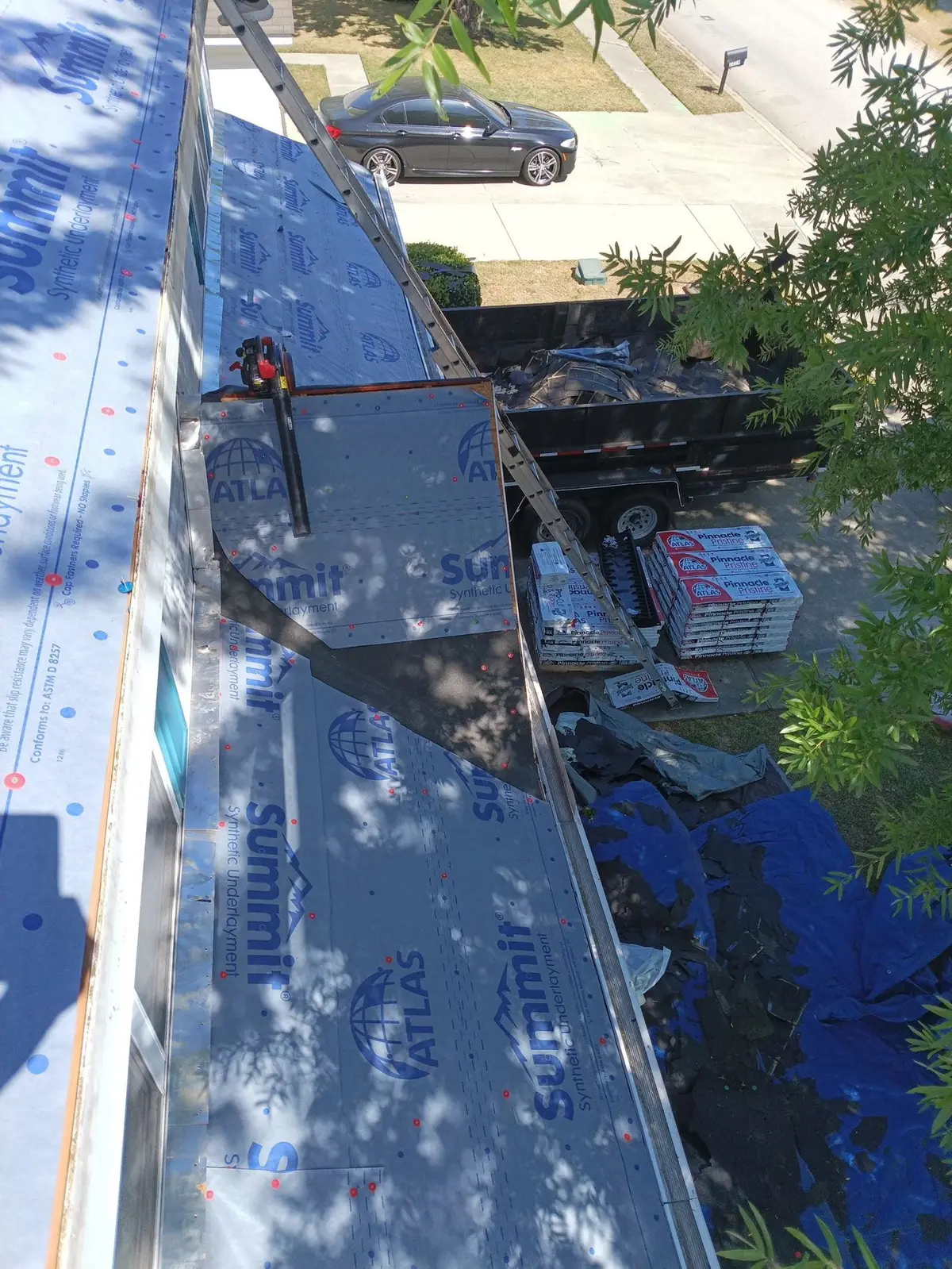
Under South Carolina's current residential code, most shingle roofs need one layer of approved underlayment, lapped 2 inches, with 4-inch end laps offset 6 feet. Roofs from 2:12 up to 4:12 need two layers. Those basics stay in the 2024 code that starts January 1, 2027. What changes is the list of approved products, the high-wind rules, and what may stay on the deck during a tear-off.
Underlayment is the sheet layer between the wood deck and the shingles. The rules sit in IRC Section R905.1.1 and its three tables: types, application and attachment. We compared the 2021 IRC and the 2024 IRC text, plus South Carolina's modifications.
Which underlayment products does the code allow?
Table R905.1.1(1) lists accepted product standards by roof covering. Products must carry a label showing the standard they meet (R905.1.1).
Approved underlayment for asphalt shingles, areas where wind design is not required
| Edition | Standards listed | Self-adhering underlayment |
|---|---|---|
| 2021 IRC | ASTM D226 Type I or II, ASTM D4869, ASTM D6757 | Allowed as an exception: a full layer of ASTM D1970, installed per both the underlayment and shingle manufacturers' instructions. |
| 2024 IRC | ASTM D226 Type I or II, ASTM D1970, ASTM D4869 Type I–IV, ASTM D6757, ASTM D8257 | Listed in the table, and a single ASTM D1970 layer is option 3 in the application table. |
South Carolina doesn't modify this table in either cycle (2024 index).
How must underlayment be applied?
Table R905.1.1(2) sets the method. For asphalt shingles in areas where wind design isn't required, both editions use slope:
- 2:12 up to 4:12: two layers. The 2021 text calls for a 19-inch starter strip at the eave, then 36-inch sheets lapped 19 inches. The 2024 text says a half-width starter strip, then full sheets lapped half a sheet plus 2 inches, which fits any roll width.
- 4:12 and steeper: one layer, applied shingle fashion from the eave, lapped 2 inches, with 4-inch end laps offset 6 feet.
- 2024 adds a third option: a single layer of ASTM D1970 self-adhering underlayment, installed per the underlayment and shingle manufacturers' instructions.
In these areas, both editions say underlayment for shingles is "fastened sufficiently to hold in place" (Table R905.1.1(3), 2024 IRC). Asphalt shingles still can't go on slopes under 2:12 (R905.2.2).
What about high-wind areas?
The IRC has a second column for areas where wind design is required under Figure R301.2.1.1. In the 2021 IRC, asphalt shingles there need two layers of underlayment. They must be attached with cap nails in a grid 12 inches apart, with 6-inch spacing at side and end laps.
The 2024 IRC offers three options in that column. One is two mechanically fastened layers. Another is 4-inch self-adhering strips over every deck joint with underlayment over the whole roof. The third is a full self-adhering layer.
For 2024, South Carolina changes that application column for asphalt shingles to match the ordinary column. The text appears as Section 8-1234 of the final regulation in the State Register of May 22, 2026. The Home Builders Association of South Carolina proposed it, arguing that underlayment should be judged on tested performance rather than prescribed installation steps (IRC 2024 34).
Read the change narrowly
The state modification rewrites only the application table, Table R905.1.1(2). The 2024 index and regulation don't modify the type table or the attachment table for wind-design areas. If your address is in such an area, ask the building office how it reads the three tables together.
Whether a Midlands address falls in a wind-design area depends on Figure R301.2.1.1 and your local Table R301.2, so ask the building office. Our post on roof wind requirements explains how design wind speed is set.
Is ice barrier the same thing as underlayment?
No. Section R905.1.2 requires an ice barrier only where Table R301.2 designates "a history of ice forming along the eaves causing a backup of water." Where required, it runs from the eave to at least 24 inches inside the exterior wall line. The text is substantively the same in 2021 and 2024.
Your local building office fills in Table R301.2 with YES or NO. We haven't found published entries for Columbia, Richland or Lexington, so ask the office that issues your permit before assuming either way.
Other underlayment changes in the 2024 IRC
- Valleys: a self-adhering membrane used to line a closed valley must now be at least 36 inches wide (R905.2.8.2, 2024).
- Metal roof panels: new Section R905.10.6 requires underlayment under metal panels per R905.1.1. In 2021, the type table left it to the manufacturer's instructions in areas without wind design. Structural metal panels that need no substrate or underlayment are exempt (R905.1.1).
- Tear-offs: existing self-adhered underlayment may stay on the deck in limited cases, covered by new compliant underlayment, if the sheathing isn't water soaked or deteriorated (R908.3, 2024). More in our re-roofing post.
Which edition applies to my roof?
The edition in effect when your permit is issued. S.C. Code §6-9-130(A) says buildings are inspected under the codes in effect on the date the original building permit is issued. A permit issued before January 1, 2027 stays on the 2021 rules. Our 2024 residential code guide covers the transition in full.
Questions to ask your roofer
- Which underlayment product are you using, and which ASTM standard is on its label?
- Is my roof under 4:12 anywhere, such as a porch, so that two layers are needed?
- Does the local Table R301.2 call for an ice barrier at my address?
- If you leave any old self-adhered underlayment on the deck, why, and what does the deck look like under it?
- How will the underlayment lap with the drip edge at the eaves and rakes?