
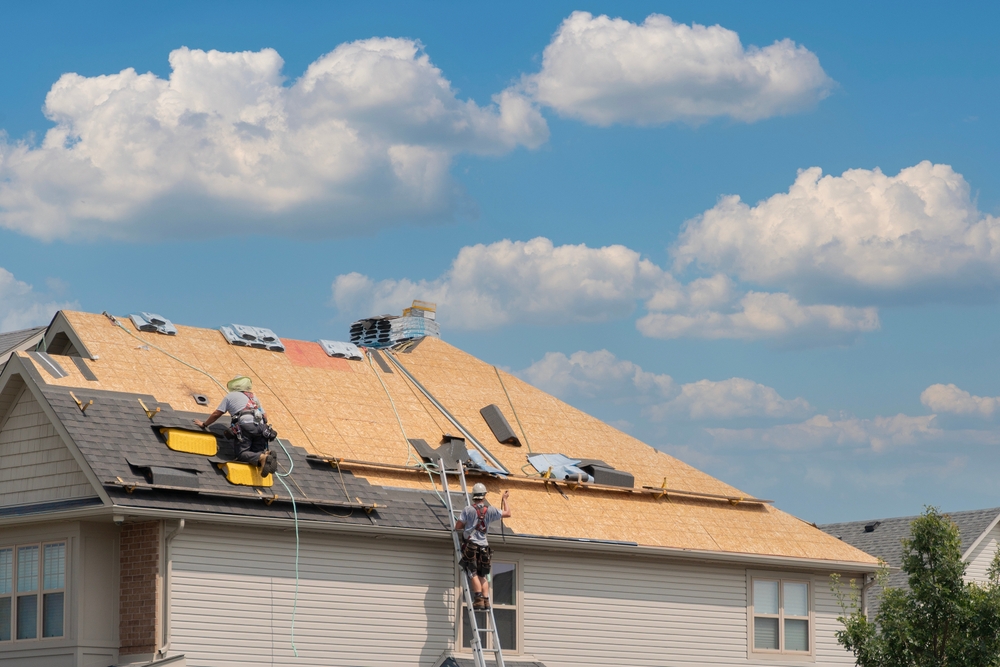
Most homeowners pay for a new roof in one of six ways: an insurance claim (only when a covered event like wind or hail damaged the roof), savings, financing arranged through the contractor, a personal loan, a home equity loan or line of credit, or a credit card. The cheapest is usually cash you already have, and the riskiest are deferred-interest promotions you can't pay off in time and home-equity debt you can't keep up with, because your house secures it. Low-income homeowners may also qualify for state or federal repair help. Before you choose, compare the total cost of each option, not just the monthly payment.
This guide walks through each option neutrally, including what to compare, how deposits and payment schedules usually work, where tax credits stand in 2026, and the help programs that actually exist in South Carolina. For what a roof costs in the first place, start with the roof replacement cost guide: it puts a full architectural-shingle replacement in the Columbia area at roughly $6,000 to $9,000 on a small home, $9,000 to $14,000 on an average suburban home and $18,000 to $30,000 or more on a large one.
The options side by side
Ways to pay for a roof, compared
| Option | When it fits | Main cost | Main risk |
|---|---|---|---|
| Insurance claim | Sudden covered damage (wind, hail, falling tree) | Your deductible; depreciation on ACV or scheduled roof coverage | Wear and tear isn't covered; the payout may not cover a whole new roof |
| Cash or savings | You have the money without draining your emergency fund | None beyond the roof | Leaving yourself without a cushion |
| Contractor-arranged financing | You want a simple monthly payment and qualify | Interest, fees, or a higher price built in for a "0%" offer | Deferred interest; terms you didn't read |
| Personal loan | Good credit; you don't want to borrow against the house | Interest (often higher than home-equity rates) | Fixed payment for the whole term |
| Home equity loan or HELOC | You have equity and a stable income | Interest and closing costs; HELOC rates usually adjust | Your home is the collateral |
| Credit card | Small repairs, or a true 0% intro APR you can pay off | High interest after any promo | Deferred-interest traps; high balances |
| Public repair programs | Low-income owner-occupants who qualify | Usually low or no cost; may come with a lien or restrictions | Waiting lists and paperwork; not for emergencies |
Rates and fees change and depend on your credit. Get written quotes before deciding.
Does insurance pay for a new roof?
Only when the roof was damaged by a covered event, and only up to what your policy pays. Homeowners insurance covers sudden damage such as wind, hail or a falling tree. It doesn't pay to replace a roof just because it's old. If you're not sure whether storm damage is involved, have the roof inspected before you decide how to pay; the roof insurance claims guide covers the claim process.
Even on a valid claim, three things usually leave you with a share of the cost:
- Your deductible. You pay it. In South Carolina a roofer may not advertise or promise to pay or rebate any part of your deductible, including a discount for putting a sign in your yard (S.C. Code §40-59-25(E)). It's a misdemeanor for the contractor.
- Depreciation. On an actual cash value policy, or a policy that pays the roof on a schedule, an older roof may receive much less than a new one costs. The SC Department of Insurance's example shows a 10-year-old $15,000 roof receiving $4,000 on ACV versus $14,000 on replacement cost, after a $1,000 deductible. See the roof age and insurance guide.
- Upgrades. If you choose a better material than you had, the difference is usually yours to pay.
If you have a mortgage, the SC DOI explains that the insurer may make the check payable to you and your mortgage company, because the lender is named on the policy, and you'll need to work with the lender to get the money released for repairs. Ask your lender early how it handles repair draws, because that affects when you can pay the roofer.
Paying cash or from savings
Paying with money you already have is the cheapest option: no interest, no fees, and no lien. The trade-off is liquidity. If paying for the roof would empty your emergency fund in the middle of hurricane season, a small loan might be the more sensible choice even though it costs interest. A middle path is to put down part of the price in cash and finance the rest, which lowers the loan cost.
If the roof isn't failing yet, savings give you time. A roof inspection can tell you roughly how many years you have, and the repair or replace guide helps you decide whether a repair can buy time while you save.
Financing arranged through your roofer
Many roofers, including Cola City Roofing, offer financing through third-party lenders. You apply through the contractor, and the lender, not the roofer, sets the rate and terms based on your credit. Our financing page describes the plans we offer. Whoever you use, treat contractor-arranged financing like any other loan and compare it with a personal loan or a home equity option before you sign.
What to check in any contractor financing offer
- The APR (annual percentage rate), not just the monthly payment.
- Any origination, application or dealer fees, and whether the roof price is higher if you finance than if you pay cash.
- Whether a "no interest" offer is a true 0% APR or deferred interest (see below).
- Whether the loan is secured by a lien on your home.
- Whether there's a prepayment penalty.
- Who the lender is, and who you'll make payments to.
The FTC lists a contractor who "says he can arrange financing through a lender he knows" and then rushes you to sign papers as a classic home improvement scam pattern: "Later, you find out you've agreed to a home equity loan with a high interest rate, points, and fees." Never sign a loan document you haven't read or that has blanks.
Deferred interest vs 0% APR
This is the most important fine print in roof financing and credit card offers. The Consumer Financial Protection Bureau explains the difference:
- 0% intro APR ("0% for 12 months"): no interest accrues during the promotion. If a balance remains afterward, you start paying interest on that remaining balance "only from the date the promotional period ends."
- Deferred interest ("No interest if paid in full in 12 months"): interest is building up in the background. If you don't pay the entire balance by the deadline, "interest going back to the date of the purchase will be added on top of the remaining balance."
The CFPB's advice is to watch for the word "if," and it warns that "the minimum payment due is usually not enough to pay off the balance by the end of the period." If you take a deferred-interest offer, divide the balance by the number of promotional months and pay at least that each month, and set a reminder well before the deadline.
Personal loans
A personal loan from a bank, credit union or online lender gives you a lump sum with a fixed rate and a fixed monthly payment, usually without using your home as collateral. That makes it simpler and less risky to your house than home-equity borrowing, but rates are often higher, and they depend heavily on your credit score. Credit unions are worth checking. Compare the APR and any origination fee, which is often taken out of the loan amount before you receive it.
Home equity loans and HELOCs
If you have equity in your home, you can borrow against it. The CFPB describes the two forms:
- A home equity loan is a lump sum, with a fixed or adjustable rate.
- A home equity line of credit (HELOC) works like a credit card secured by your house: you can draw, repay and draw again up to a limit. HELOCs "usually have adjustable interest rates and the payment will vary depending on the outstanding balance."
Rates are often lower than unsecured loans because the house secures the debt, but that's the risk too. In the CFPB's words, if you can't repay a home equity loan or line of credit, "you could potentially lose your home." Factor in closing costs and appraisal fees, which can make home equity borrowing poor value for a small amount.
Federal law gives you a cooling-off period on most of these loans. For most non-purchase mortgages on your principal dwelling, including home equity loans and HELOCs, you generally have three business days to cancel (the "right of rescission"); you must cancel in writing, and the lender must return your money within 20 calendar days of receiving your notice, according to the CFPB.
Credit cards
Credit cards make sense for small repairs or a true 0% intro APR you're certain you can pay off within the promotional period. For a full roof, standard card rates make this an expensive way to borrow, and store or contractor cards often carry deferred-interest promotions. If a roofer charges a card fee, ask about it up front.
Deposits and payment schedules
However you pay, how much you pay before the work matters. The FTC's advice is: "Don't pay the full amount for the project up front" and "never make the final payment until the work is done and you're satisfied with it." It also lists paying everything up front or in cash as a scam sign.
- Tie payments to milestones: a reasonable deposit at signing or material delivery, and the balance after completion and your walk-through.
- Pay by check or card, not cash, and get a receipt for each payment.
- On an insurance job, a South Carolina roofer can't require payment until your five-business-day cancellation period after any written coverage denial has passed, except for emergency services you acknowledged in writing (§40-59-25(C)).
- Collect lien releases from the contractor (and suppliers, if any) before the final payment.
The roofing contractor guide covers contracts, deposits, liens and cancellation rights in detail.
Cancellation rights when you finance at home
If a contractor sells you a roof on credit at your home, South Carolina's home solicitation sale law gives you until midnight of the third business day after you sign to cancel (S.C. Code §37-2-502), in addition to the FTC's Cooling-Off Rule for sales made at your home. Both have emergency exceptions if you request immediate work in a signed, handwritten statement, so don't sign a waiver for anything beyond genuine emergency work.
Are there tax credits for a new roof in 2026?
For most homeowners, no. Two points:
- Federal. The IRS noted in 2023 that "metal roofs or asphalt roofs with pigmented coatings or cooling granules primarily designed to reduce heat gain no longer qualify" for the Energy Efficient Home Improvement Credit (Section 25C). And the credit itself now only applies to qualifying property placed in service before the end of 2025, according to the IRS's credit page. A roof installed in 2026 doesn't qualify. Be skeptical of any sales pitch that says otherwise.
- South Carolina. S.C. Code §12-6-3660 allows a state income tax credit for retrofitting a legal residence to resist hurricanes and windstorms, limited to the lesser of 25% of the cost or $1,000. It excludes "ordinary repair or replacement of existing items" and only covers fortification measures defined by Department of Insurance regulation, so an ordinary reroof isn't likely to qualify on its own. Ask a tax professional before counting on it.
Whatever you decide, keep the roof invoice with your home records and ask a tax professional how it applies to your situation.
Help programs for South Carolina homeowners
A few public programs help qualifying homeowners pay for roof work. They're worth knowing about, but they have income limits, paperwork and waiting lists, so they're not a fix for a roof that's leaking today.
SC Housing Trust Fund Home Repair Program
SC Housing (the South Carolina State Housing Finance and Development Authority) funds home repairs for low-income homeowners through its Housing Trust Fund. Under its Home Repair Program manual effective April 20, 2026:
- Homeowners must own and live in the home as their primary residence and have household income at or below 80% of the area median income.
- Roof replacements are on the list of eligible repairs, along with gutters, fascia and soffits.
- Eligible repairs "must not be covered by existing insurance policies."
- Homeowners don't apply to SC Housing directly. Applications go through approved "sponsor" organizations that serve defined areas and keep waiting lists.
- Assistance of $15,000 or more requires a 20-year land use restriction agreement recorded against the property.
To find a participating sponsor in your county, contact SC Housing.
USDA Section 504 Home Repair loans and grants
USDA Rural Development's Section 504 program helps very low-income owner-occupants in rural areas. Under the federal regulations (7 CFR part 3550):
- Loans can be used for "general repairs and improvements" or to remove health and safety hazards. Section 504 loans carry a 1% interest rate and a 20-year term.
- Grants are only for applicants aged 62 or older, and only for repairs that remove identified health and safety hazards or improve accessibility.
- Household income must not exceed the very low-income limit, and applicants must be unable to get affordable credit elsewhere.
- The property must be in an eligible rural area. Check the address on USDA's eligibility map.
Maximum loan and grant amounts are set by USDA and change over time, so ask your local Rural Development office for current limits.
FHA Title I property improvement loans
HUD's Title I program insures loans made by approved private lenders for "alterations, repairs, and site improvements" on single-family homes. The home must have been completed and occupied for at least 90 days, and Title I balances over $7,500 must be secured by the property. You apply through a HUD-approved Title I lender, not HUD.
SC Safe Home
The SC Department of Insurance's SC Safe Home grant program pays for wind-resistance retrofits, but only in designated coastal counties (Beaufort, Berkeley, Charleston, Colleton, Dorchester, Florence, Georgetown, Horry, Jasper, Marion and Williamsburg), and as of October 6, 2026 it was not accepting applications. It doesn't cover Richland or Lexington County homes.
How to compare your options
- Get a written roof price first, with the scope spelled out. The estimates guide shows what should be in it.
- Find out whether insurance applies. If not, rule it out and move on.
- Get at least two financing quotes in writing, for example the contractor's lender and your bank or credit union.
- Compare the APR, all fees, the term, the monthly payment and the total amount you'll repay.
- Check whether the loan is secured by your home and whether there's a prepayment penalty.
- For any "no interest" offer, confirm whether it's 0% APR or deferred interest, and work out the monthly amount you'd need to clear it in time.
- Ask whether the roof price changes if you pay cash.
Avoiding roof payment scams
- Be wary of door-to-door offers that come with on-the-spot financing. Check the roofer on the SC Residential Builders Commission lookup first.
- Don't pay everything up front, and don't pay in cash.
- Don't sign loan papers with blank spaces, or that you haven't had time to read.
- Don't accept an offer to cover your deductible. It's illegal for a roofer to make one in South Carolina.
- Be skeptical of tax credit claims for roofs in 2026.
- Don't sign over your insurance claim (an assignment of benefits) to pay for the job without understanding what rights you're giving up.
If you'd like a written price to start your comparison, Cola City Roofing gives free estimates across Columbia and the Midlands. Contact us when you're ready.
General information, not financial or tax advice
Loan terms depend on your credit and the lender. Program rules and tax law change; they were checked on October 6, 2026. Talk to your lender, insurer or a tax professional about your situation.