
After a new roof goes on, three things matter most: make sure the manufacturer's warranty is registered (and find out who is doing it), put every document from the job in one place, and tell your homeowners insurer the roof is new. After that, the first year is mostly about knowing what's normal (loose granules in the gutters, shingles that take some warm, sunny weather to seal down) and what isn't (a leak, lifted shingles, nail heads pushing up), and setting up a simple routine of spring and fall checks.
This guide walks through each of those. Warranty details come from the manufacturers' own warranty documents, which differ between brands and between warranty levels within a brand. Your warranty document, not this guide, controls your coverage, so read it. For how manufacturer and workmanship warranties work in general, see our roofing warranties guide.
Is my roof warranty registered, and who registers it?
There are usually two warranties on a new roof, and they work differently.
- The manufacturer's warranty covers defects in the shingles and, at higher levels, other parts of the roofing system. Its terms are set by the manufacturer in a printed warranty document.
- The contractor's workmanship warranty covers installation errors. Its terms are whatever your contract says. Our blog post on manufacturer vs workmanship warranties explains the difference.
Standard manufacturer warranties
Every major shingle comes with a standard limited warranty. How registration works for it depends on the brand. Owens Corning, for example, runs an online warranty resource center where homeowners, contractors and property managers can register a standard product or standard system warranty. Registration asks for the owner, the property, the contractor, the product and supporting documents such as proof of ownership and proof of installation. CertainTeed has its own online warranty and claims portal. Check your manufacturer's site, or ask your contractor, whether registration is required for your product or just recommended, and do it while the paperwork is fresh.
Enhanced (system) warranties need a credentialed installer
Manufacturers also offer enhanced warranties that can add longer non-prorated coverage, cover more of the roofing system, and in some cases cover the installer's workmanship. These are only available when a contractor holding the manufacturer's credential installs a qualifying system, and the contractor registers them. Two examples from the manufacturers' own documents:
- Owens Corning. The Preferred Protection warranty requires installation by an Owens Corning Roofing Platinum or Preferred Contractor, and the contractor must register it within 60 days of installation. The Platinum Protection warranty requires a Platinum Preferred Contractor and has the same 60-day contractor registration. Owens Corning's warranty help page states that Preferred and Platinum Preferred contractors must register these system warranties on the homeowner's behalf.
- CertainTeed. CertainTeed says contractors holding its SELECT ShingleMaster designation can offer a 5-Star extended warranty, under which CertainTeed covers the contractor's workmanship for 25 years.
If your contract promises an enhanced warranty, ask the contractor three things: which credential they hold (and check it on the manufacturer's contractor locator), which specific warranty they are registering, and when you will receive the registration confirmation or certificate. Under Owens Corning's documents, a system warranty that was improperly registered isn't covered, so the confirmation matters.
If the contractor doesn't hold the credential
A roofer without the manufacturer's credential can still install that manufacturer's shingles correctly, and you still get the standard limited warranty. What you can't get is that manufacturer's enhanced warranty. Be wary of any contract that names an enhanced warranty when the contractor can't show the credential.
The workmanship warranty is separate. Read how long it lasts, what it covers (leaks caused by installation errors, typically) and what you need to do to make a claim. Get it in writing; a verbal promise is hard to enforce. If you ever sell the house, check whether each warranty transfers: Owens Corning's Preferred Protection warranty, for instance, can be transferred once, and the new owner must apply within 60 days after the sale with proof of purchase, the installation date and ownership history and a $100 fee. CertainTeed says its shingle warranties can be transferred once, from the original owner to the next, without a fee.
What documents should I keep after a new roof?
Make one folder, paper or digital, and put everything in it the week the job finishes. Most of these are hard to recreate years later, when you need them for a warranty claim, an insurance claim or a sale.
New roof document checklist
| Document | Why you need it |
|---|---|
| Signed contract and all signed change orders | Defines the scope, the products and the workmanship warranty |
| Final invoice and proof of payment | Proof of purchase and installation date for warranty claims and transfers |
| Manufacturer warranty document and registration confirmation | Shows which warranty applies and that it was registered |
| Written workmanship warranty | The contractor's terms, if not already in the contract |
| Building permit and final inspection approval | Shows the work was permitted and passed inspection; useful for insurance and a sale |
| Lien releases (lien waivers) from the contractor and major suppliers | Protects you from liens for labor or materials you already paid for |
| Photos: before, during (especially decking and flashing) and after | Records what is under the shingles and the roof's condition on day one |
| Product labels or bundle wrappers | The wrapper shows the product name and often a lot or production code that a manufacturer may ask for |
| Contractor's registration number and certificate of insurance | For your records and any future claim |
| HOA approval, if applicable | Shows the product and color were approved |
A word on lien releases. Under South Carolina law, a person who supplied labor or materials for work on your home has 90 days after they last furnished labor or materials to serve and file a mechanic's lien statement (S.C. Code §29-5-90). Collecting releases from the contractor and major suppliers before or at final payment is the simplest protection. The roofing contractor guide explains how to time payments and releases.
For bundle wrappers, ask the crew to set one aside for you on install day, or take a clear photo of the label. For the permit, ask your contractor for a copy of the final approval; who issues it depends on your town or county, as covered in roof permits in Columbia and the Midlands.
Keep a digital copy as well as paper. Scan or photograph each document, save the files somewhere other than your phone (a cloud folder or an email to yourself works), and name them so you can find them later, for example "2026 roof - final invoice." If you sell the house, the buyer will want copies of the warranty, the permit approval and the invoice, and some warranty transfers require proof of purchase and the installation date, so having everything in one folder makes the sale and the transfer simpler.
Should I tell my insurance company I have a new roof?
Yes. Call your agent or insurer, tell them the roof was replaced, and give them the completion date, the material and the contractor's information. Send a copy of the final invoice and, if you have it, the permit's final approval. Many insurers look at roof age when they price or renew a policy, so make sure their records show the new date. Ask whether anything about your coverage or premium changes.
Our guide to roof age and homeowners insurance covers why roof age matters to insurers and what to ask. If the new roof was paid for through a claim, keep the claim file with your roof documents too; see the roof insurance claims guide.
What's normal in the first months after a new roof?
Granules in the gutters
Some loose granules in the gutters and at the bottom of downspouts are normal on a new shingle roof. Shingle makers apply more granules than will stick, and some loose "hitchhiker" granules end up in the bundles. IKO's technical bulletin says these come off during the first few years of exposure and that losing them is normal and doesn't reduce the shingles' weatherproofing life. Granule loss becomes a concern when bare spots of asphalt show on the shingle surface.
Shingles sealing down
Asphalt shingles have strips of sealant that bond each course to the one below once the roof gets warm. Owens Corning's warranty explains that its sealant needs direct warm sunlight for several days to seal, that shingles installed in cool weather may not seal until the weather warms, and that shingles are more vulnerable to blow-offs before they seal. That's why a roof installed in late fall or winter can look a little less flat at first. In the Midlands, warm days usually come soon enough, but if you see tabs lifting in wind after the first warm spell, call your contractor.
Small cosmetic differences
Slight shading differences between areas of a new roof can come from how light hits each slope. If one area looks clearly different, raise it with your contractor at the walkthrough. Owens Corning's warranty, for example, lists shading and color variation among the conditions it doesn't cover, so a warranty claim is unlikely to fix it later.
What isn't normal
- Any leak, water stain or damp insulation, however small.
- Shingles that are lifted, creased or missing after the shingles have had warm weather to seal.
- Nail heads pushing up through or under shingles (nail pops), or bumps along the deck lines.
- Flashing that has pulled away from a wall or chimney, or gaps around pipe boots.
- A sag or wavy line that wasn't there at the walkthrough.
- Bare patches where the granules are gone and asphalt is exposed.
If you see any of these, call the contractor who installed the roof first. Owens Corning's system warranties, for example, make the installing contractor responsible for repairing application errors discovered in the first two years. Report the problem in writing with photos and the date.
What can void a roof warranty?
Warranty documents list what isn't covered, and some of those items are things homeowners do without thinking. Owens Corning's Preferred Protection warranty, for example, excludes damage caused by improper or inadequate ventilation; foot traffic and falling objects such as tree branches; non-Owens Corning products such as flashing, counterflashing and pipe boots; and alterations after installation, including equipment or solar panel installation, power washing, painting, coatings and cleaning solutions not used per the manufacturer's algae-removal instructions. Other brands have similar lists.
- Don't pressure wash the roof. Follow the manufacturer's cleaning guidance for algae.
- Ask before mounting anything on the roof, including solar panels, satellite dishes and antennas. Solar installation is a named exclusion in some warranties unless done under the manufacturer's program.
- Keep ventilation working. Don't cover soffit vents with insulation or block ridge vents.
- Limit foot traffic. Have trades walk the roof only when necessary.
- Use your installer for repairs during the workmanship period, or check your warranty before hiring someone else.
Our blog post on what voids roofing warranties covers more examples.
What should I check in the first year?
A new roof needs little, but the first year is when installation problems show up. Use the checklist below, from the ground and the attic. Don't climb on the roof.
First-year checks
| When | What to check |
|---|---|
| After the first heavy rain | Look in the attic for drips, stains or damp insulation, especially around chimneys, vents and valleys. Check ceilings below. |
| After the first warm spell | From the ground, look for tabs that haven't sealed or are lifting in wind. |
| Spring and fall | Clean gutters and downspouts; note granule amounts; look for lifted or missing shingles and loose flashing; check the attic for daylight and moisture. |
| After any major storm | Look from the ground for missing shingles or damage; check the attic. In the Midlands, hurricane season runs June 1 through November 30, and summer thunderstorms can bring strong wind. |
| Near the end of the first year | Ask your contractor whether they do a one-year check, and walk the roof's condition against your day-one photos. |
Gutters
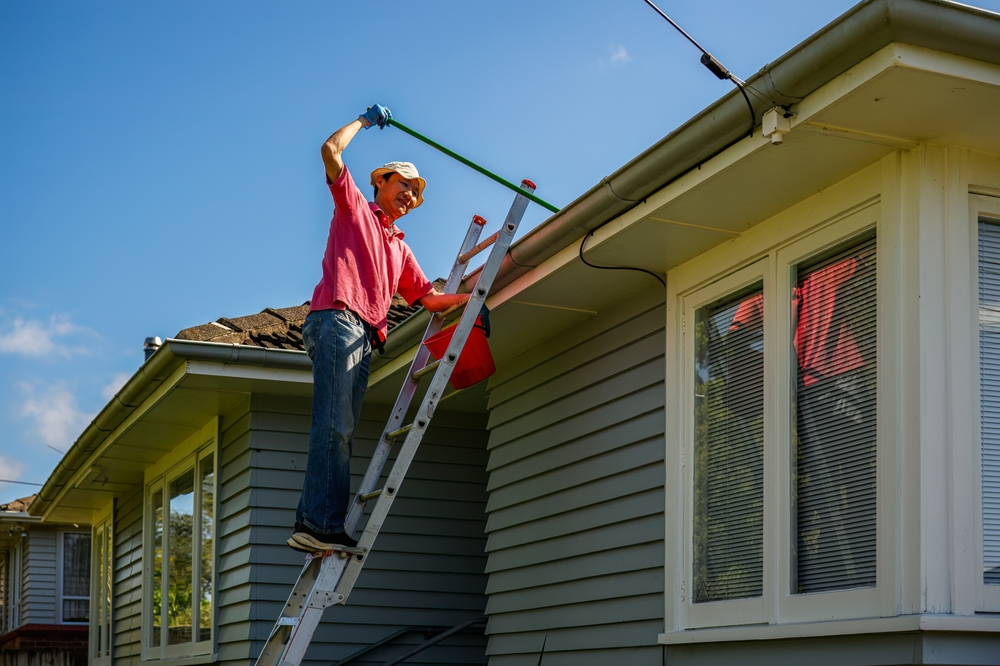
Gutters that drain well protect the new roof edge and fascia. Clear them in spring and fall, and more often under trees; pine straw and leaves fill Midlands gutters quickly. Expect some granules in the first gutter cleanings. See the gutter maintenance guide for how to clean them safely.
Attic
The attic is where a leak shows first. On a dry day, look for light coming through the deck anywhere other than designed vents. After rain, look for wet spots and stains. Check that insulation isn't covering the soffit vents. If the crew added or changed ventilation, the attic should feel less hot and stuffy in summer than it did before. The roof ventilation guide explains what balanced ventilation looks like.
How often should a new roof be inspected?
Plan on a check each spring and fall, plus after major storms, which is the routine our roof maintenance guide recommends. Most of it you can do from the ground and the attic. A professional inspection every so often, and after any storm that causes visible damage, catches what you can't see from below. Keep notes and photos with your roof documents so you can show the roof was cared for if you ever make a warranty or insurance claim.
If you'd like a second opinion on something you've spotted on a new roof, Cola City Roofing inspects roofs across the Midlands. Contact us.