On older Camden houses, roof leaks tend to start at a handful of predictable places: the chimney, the valleys, and the flashings and boots where something passes through the roof. A good repair finds the actual entry point, fixes it, and checks the wood around it. A patch that only covers the spot above the stain often fails again.
This page covers the repairs we see most on Camden roofs, what a ceiling stain tells you, what to do while you wait, and how to tell when repair is no longer the right call. It is part of our Camden roofing page.
Chimney leaks: flashing and crickets
A brick chimney is a hole in the roof sealed with metal. Step flashing is woven into the shingles along the sides, and counterflashing is set into the mortar joints and lapped over it. On the uphill side, a chimney of any real width needs a cricket, a small peaked frame that splits water around the chimney instead of letting it pool against the brick. When any of those parts wears out, water runs straight down the chimney into the deck and framing.
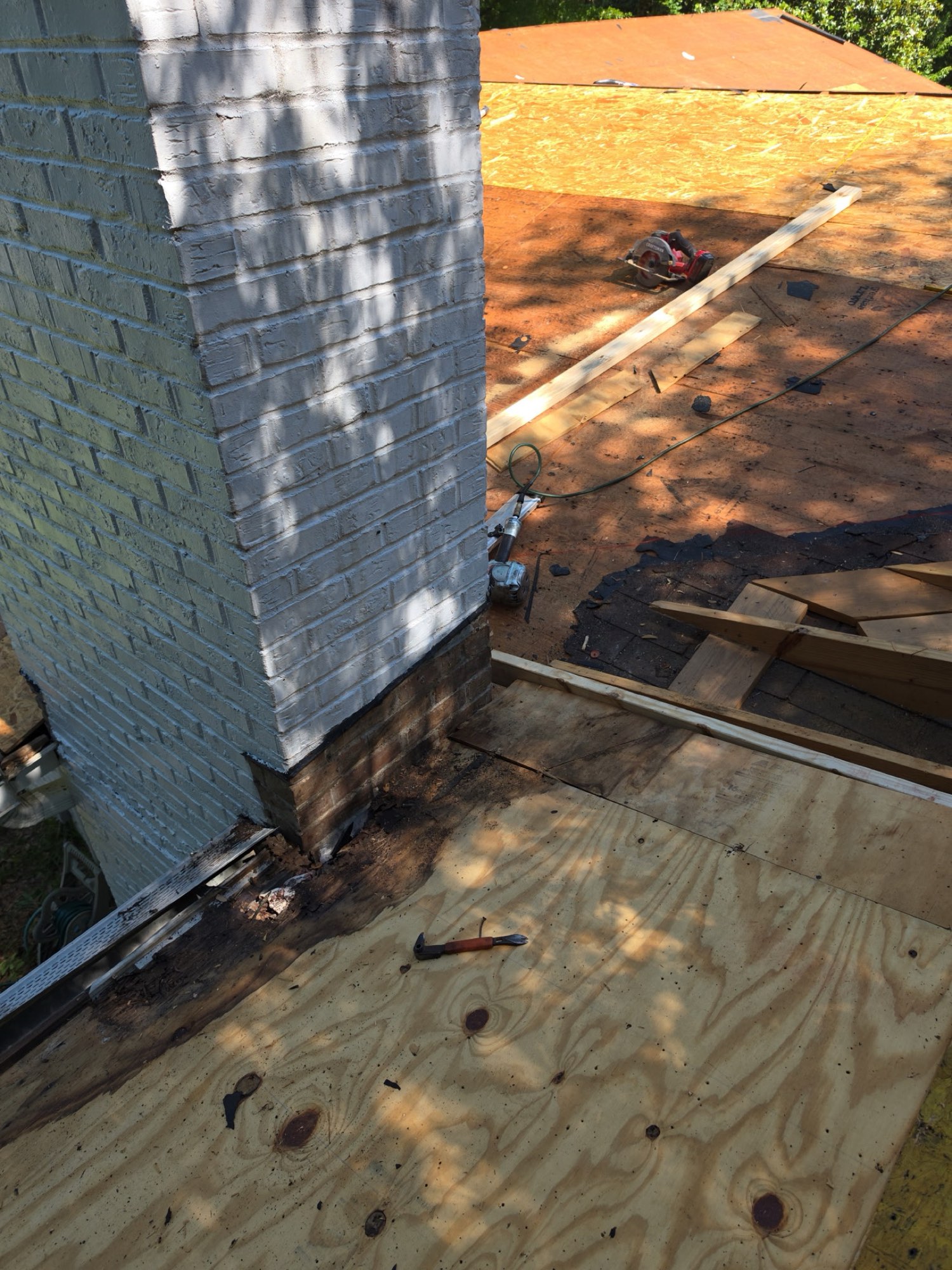
Our Camden roof replacement is a clear example. When we stripped the roof at the chimney, we found two crickets that earlier roofers had installed, and both had failed. Underneath was a second layer of old shingles and deteriorated flashing. The sheathing and framing along the flashing line had gone soft and dark from years of water getting past the old counterflashing.
A sound chimney repair replaces the flashing as a system: step flashing, counterflashing cut into the mortar, and a cricket framed into the deck and flashed with the roof. Caulk smeared over old metal is not a repair. If the brick or mortar is crumbling, the counterflashing has nothing solid to hold, so the masonry may need work first.
Valleys under leaves and pine straw
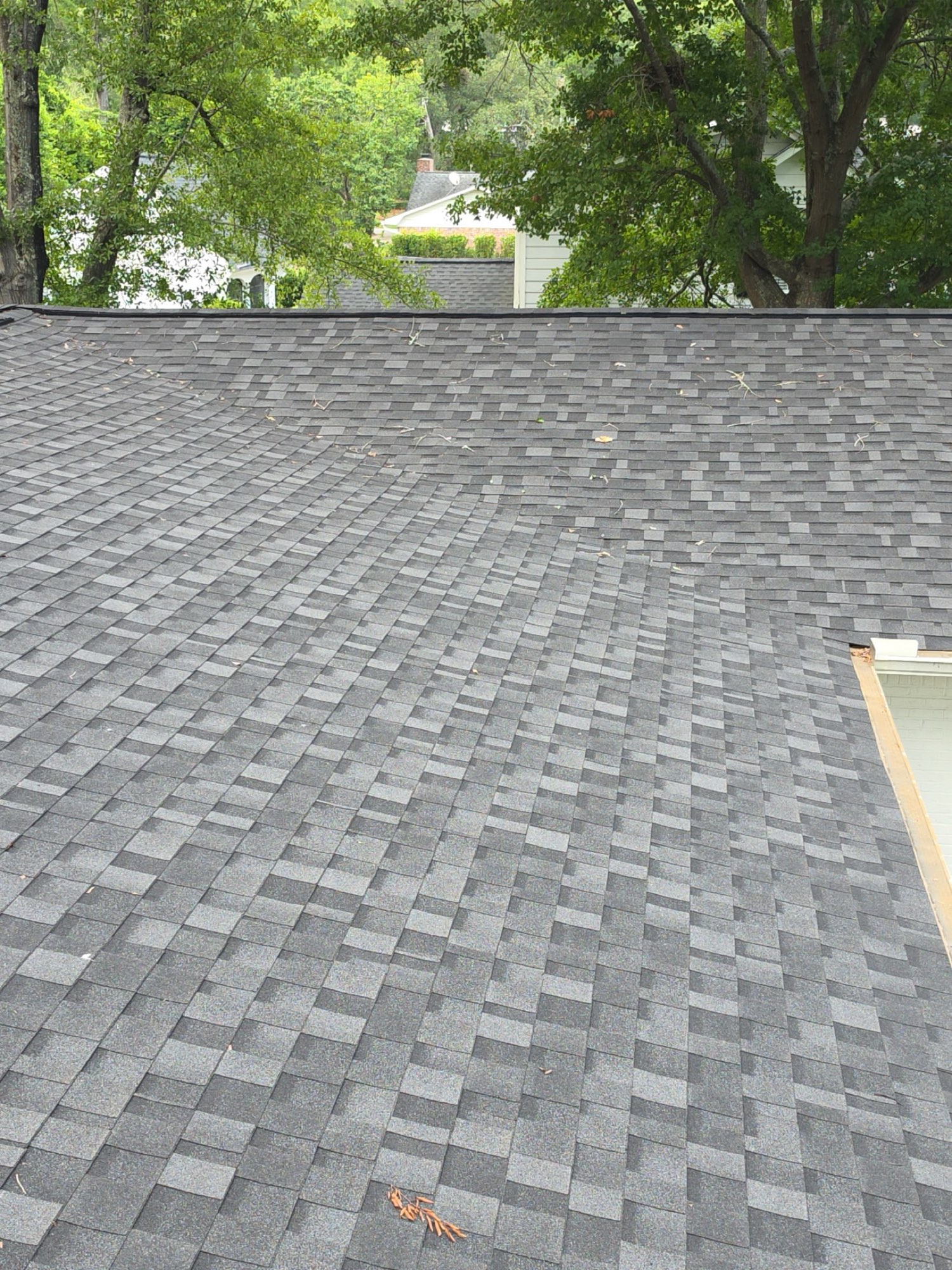
Valleys carry more water than any other part of a roof, and on Camden's shaded lots they also collect leaves and pine straw. On the same job, debris was packed into the valleys and along the gutter line, holding moisture against the shingles, and moss had taken hold on the worn shingles. Debris in a valley slows the water, pushes it sideways under shingle edges and keeps the area wet long after a rain. Clearing valleys is maintenance, but once the shingles or the underlayment in a valley have failed, the valley needs to be rebuilt. See trees, shade and your Camden roof for how to keep valleys clear.
Leaks that reach the ceiling
By the time a stain shows on a ceiling, water has gone through the roofing, the deck and the insulation. Water also travels along rafters and the top of the drywall before it drips, so the stain is often some distance from the hole. On our Camden job, the stain was spreading across a bathroom ceiling around the exhaust fan.
A stain near a bath fan can come from a roof leak, from condensation if the fan is vented into the attic instead of outside, or from both. A roofer should check from the attic as well as the roof. What to do inside:
- Move belongings and catch drips. If the ceiling is sagging or bulging, keep people out of the room and do not poke it while standing underneath.
- Photograph the stain and any damage, with dates, before anything is cleaned up.
- Turn off power to a light or fan fixture that has water in it.
- Note when the leak shows up: every rain, only in wind-driven rain, or only after long storms. That helps find the source.
Temporary tarping
A properly installed tarp is a stopgap to keep water out until the permanent repair. It should extend past the damaged area, be fastened so wind cannot get under it, and not trap water against the roof. Keep receipts; most homeowner policies expect you to take reasonable steps to prevent further damage. If water is coming in now, see emergency roof repair. After a storm, our page on storm and tree damage to Camden roofs covers the first steps.
Other common repairs
- Cracked or split rubber boots around plumbing vent pipes.
- Shingles lifted or torn off by wind, especially along edges and ridges.
- Exposed or backed-out nails that let water in at the fastener.
- Rotted fascia or roof edges where gutters have overflowed for years.
- Damage from limbs, which can crack decking without leaving an obvious hole.
Our roof repair guide explains how each of these is fixed.
When repair stops making sense
Repair is the right call when the leak has one clear source and the rest of the roof has life left. It stops making sense when the shingle field itself is worn out, with granule loss, curling or brittle tabs across the slopes. It also stops making sense when the roof already has two layers, because a proper repair has to go through both, or when rot has spread from the leak into the deck and framing. Our Camden job had all three: a worn, mossy shingle field, a second layer, and rot at the chimney base that had to be cut out. That house needed a full roof replacement in Camden, not another patch.
The repair or replace guide walks through the decision in more detail. If your roof is older, also read roof age and homeowners insurance.
Permits and historic houses
Camden's building permit page says a permit is required for any repair or enlargement inside city limits, so ask whether your repair needs one before work starts. Contractors also need a City of Camden business license. The Kershaw County and Camden roof permit guide has the details.
If your house is on the city's locally designated historic list, the city's ordinance allows ordinary repair that keeps the same material, design and appearance to be approved by the Building Official without going to the Historic Landmarks Commission. Changing materials needs a Certificate of Appropriateness. Call the city at 803-432-2421 if you are not sure which side your repair falls on. See re-roofing a historic home in Camden.
Get a Camden roof repair
Cola City Roofing repairs roofs across Camden and Kershaw County. We find the entry point, photograph what we see from the roof and the attic, and give you a written scope and price before work starts. Contact us or call (803) 734-3700, and read more about our roof repair services.