
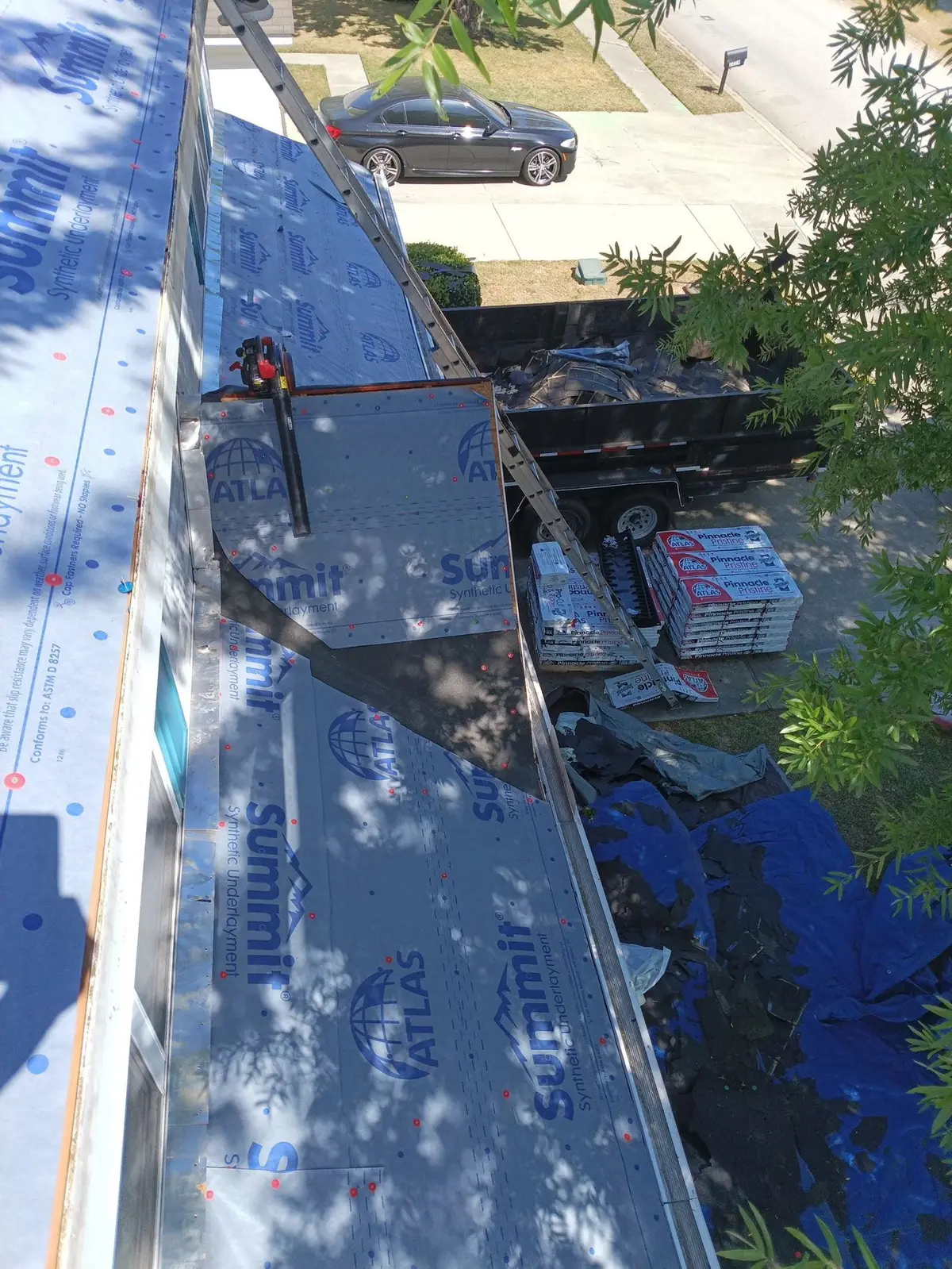
A manufactured home in South Carolina usually has one of two roofs: a low-slope metal roof, common on older single-wides, or a pitched shingle roof like a site-built house. When it leaks or wears out, you have four choices: repair the problem spot, coat the roof, build a new roof over the old one, or replace it. Which one fits depends on the condition of the structure underneath, the wind zone the home was built for, and who is legally allowed to do the work.
That last point matters more than most owners expect. South Carolina licenses people who repair manufactured homes through a separate board, and the rules don't line up neatly with roofing registration. This guide explains the options, the federal HUD Code points that affect a roof, the state licensing rules, local permits and the questions to ask before anyone climbs a ladder. Every rule here links to the statute, regulation or agency page it comes from.
Mobile home or manufactured home?
People say both. The federal construction standards apply to homes that entered production on or after June 15, 1976, according to 24 CFR 3282.8. South Carolina law uses the term "manufactured home" for a home built on a permanent chassis that is at least 8 feet wide or 40 feet long in transit, or 320 square feet once set up (S.C. Code § 40-29-20(9)). This guide uses "manufactured home" except where people search for "mobile home".
What kind of roof does a manufactured home have?
Low-slope metal roofs
Many older homes have a single sheet of metal running over curved or shallow trusses. The HUD standard allows one-piece metal roofing to be used without structural sheathing, as long as the roofing passes HUD-approved testing for wind pressure (24 CFR 3280.305(c)(1)(iii)). In plain terms, there may be no wood deck under the metal at all. That changes how a roof can be walked on, fastened to and repaired.
The same section says roofing membranes must be stiff enough to stop water from ponding or seams from pulling apart. Where a metal roof is cut for a vent or pipe, the penetration must be flashed and sealed over a plywood backer at least 5/16 inch thick, fastened to the framing below (24 CFR 3280.305(h)).
Pitched shingle roofs
Many newer homes, especially multi-section homes, have a pitched roof with sheathing, underlayment and asphalt shingles. These look and age much like a site-built roof. The HUD wind-pressure table for roof coverings applies to slopes between 10 degrees (about 2/12) and 30 degrees (24 CFR 3280.305(c)(1)).
Find your data plate first
Every HUD-code home has a data plate, often inside a kitchen cabinet, bedroom closet or near the electrical panel. Federal rules require it to show the wind zone and roof load zone the home was designed for (24 CFR 3280.305(c)(4)). Photograph it before you talk to any contractor. It tells them what the roof was engineered to carry.
Repair, coating, roof-over or replacement?
The four options solve different problems. A coating can't fix rotten framing, and a full replacement is more than a single loose vent needs. Start with the condition of the roof, then pick the option that matches it.
Four ways to deal with a worn manufactured home roof
| Option | What it is | When it fits | What to check |
|---|---|---|---|
| Repair | Fix one problem area: reseal a seam, replace a vent boot or flashing, refasten loose metal or shingles. | The roof is sound overall and the leak has a clear source. | Whether the fix touches framing; a metal penetration needs a plywood backer under § 3280.305(h)(4). |
| Coating | A liquid layer rolled or sprayed over the existing roof. The U.S. Department of Energy describes coatings as "like very thick paints" (DOE cool roof guide). | The roof is in good condition, or in moderate condition with minor repairs made first, per the same DOE guide. | The product label lists your roof surface; seams and penetrations are sealed first, per the manufacturer data sheet. |
| Roof-over | A new roof, usually metal panels on wood purlins or furring strips, fastened through the old roof into the framing. | The structure is sound, but the old roof can't take more patching. | Added weight, fastening into trusses, wind uplift at edges, and whether new framing is a structural change. |
| Replacement | Remove the old covering, repair what's underneath, and install a new roof. | Soft spots, sagging, widespread rust-through or repeated leaks in different places. | Framing condition, the data-plate zones, and who is licensed to repair structure. |
The DOE guide puts the decision plainly: if a roof is in poor condition or near the end of its life, it is usually best to re-cover, replace or retrofit it rather than coat it (DOE, Guidelines for Selecting Cool Roofs). Our posts on metal roof-overs, finding and fixing leaks and coating versus replacement go deeper on each option.
How the HUD Code affects roof work
A manufactured home is engineered as one connected structure. The HUD standard requires roof framing to be fastened to the walls, the walls to the floor, and the floor to the chassis, so the home resists wind uplift and sliding (24 CFR 3280.305(a)). A new roof that adds weight or changes how the roof is fastened affects that load path.
Roof load: all of South Carolina is in the South zone
HUD sets three roof load zones. South Carolina doesn't appear in the North or Middle lists, so the whole state falls in the South Roof Load Zone, designed for a 20 pounds per square foot live load (24 CFR 3280.305(c)(3)). That figure is the live load the roof was designed to resist. It is not spare capacity for extra roofing layers.
Don't cut the framing
The standard bans cutting roof framing members to run electrical, plumbing or mechanical lines unless an engineering analysis supports it (24 CFR 3280.305(h)(3)). The same caution applies to any roof project that trims, notches or removes trusses.
Additions, alterations and the HUD label
The HUD certification label, often called the HUD tag, is the manufacturer's statement that the home met the HUD Code when it was built (HUD homeowner resources). In federal rules, an "alteration" means a change made after the manufacturer sells to a retailer but before the retailer sells to a buyer (24 CFR 3282.7). HUD doesn't publish a rule that addresses a homeowner's later roof replacement directly.
HUD's homeowner guidance does warn that a significant change, such as an addition or structural alteration, may require local permits and could take the home out of compliance with the HUD Code. It adds that the manufacturer is not responsible for damage caused by alterations, and that changes could affect your warranty (HUD homeowner resources). For a roof-over that adds new framing, ask the home's manufacturer before work starts.
Which South Carolina counties are Wind Zone II?
HUD lists nine South Carolina counties in Wind Zone II, which is designed for a 100 mph wind: Beaufort, Berkeley, Charleston, Colleton, Dorchester, Georgetown, Horry, Jasper and Williamsburg (24 CFR 3280.305(c)(2)). No South Carolina county is in Wind Zone III. Every other county is Wind Zone I, including Richland, Lexington, Kershaw, Fairfield, Newberry, Saluda, Calhoun, Orangeburg, Sumter and Aiken.
Zone I homes are designed for a horizontal wind load of at least 15 pounds per square foot and a net roof uplift of at least 9 pounds per square foot. Zone II homes, and their roofing and fasteners, must be designed by a professional engineer or architect (24 CFR 3280.305(c)(1)). HUD also says a home should never be placed in a more restrictive wind zone than it was built for (HUD homeowner resources). If you bought a used home that moved from the Midlands to the coast, check the data plate.
For how wind rules apply to site-built roofs in the state, see our post on roof wind requirements in the SC code.
Who is allowed to repair a manufactured home roof in South Carolina?
South Carolina requires a license from the Manufactured Housing Board for paid work on certain parts of a manufactured home. The statute says no manufactured home repairer "may modify, alter, or repair the structural, mechanical, or electrical systems of a manufactured home without holding a license issued or recognized by the board" (S.C. Code § 40-29-30(A)). A contractor license, which covers installing as well as repairing, carries the same limit.
The board's regulations define "repair" as "the renewal, replacement or reconstruction of any structural, mechanical, or electrical component of an existing manufactured home for the purpose of its maintenance" (S.C. Code Regs. 79-1(Y)). A repairer license covers repair of "components, systems, appliances, fixtures or devices". A contractor license covers everything an installer or repairer may do, plus porches, decks, ramps and add-on components (Regs. 79-22 and 79-23).
The exception for other state licenses
The same regulations say a manufactured housing license "is not required for persons holding a current license issued by other Boards or commissions of the state." Their work on manufactured homes "is restricted to the specific discipline and conditions of the license held" (Reg. 79-24(D)). Roofers are one of the specialty trades under the Residential Builders Commission, and that chapter defines "license" to include a registration (S.C. Code § 40-59-20).
Read together, a roofer with a current Residential Builders Commission registration may fall under that exception for roofing work. Two points are unsettled, though. The statute's own definition of a repairer only excludes people licensed by the Manufactured Housing Board or the Contractor's Licensing Board (§ 40-29-20(14)). And a roof-over that adds framing may go beyond roofing into structural work.
Ask the board, in writing
Neither the statute nor the board's website says outright whether re-roofing a manufactured home needs a Manufactured Housing Board license. If your job includes new framing, truss repair or anything structural, email the board at Contact.MH@llr.sc.gov or call (803) 896-4682, as listed on the Manufactured Housing Board page, and ask which license the job needs.
How to check a license
Use the Licensee Lookup on the Manufactured Housing Board page for a repairer or contractor license. For a roofer's Residential Builders Commission registration, follow our guide to checking a roofer's license in SC. State law requires a registration for residential specialty work over $500 (§ 40-59-20(7)).
A board-licensed repairer must carry the license and show it on request (§ 40-29-200(E)). The law also gives you a warranty: a repairer warrants the work for at least 90 days, and a contractor for 12 months (§ 40-29-260).
If you do the repair yourself, HUD's guidance says you should be able to make repairs to your own home. If the home is still under the manufacturer's warranty, the manufacturer's authorization may be required (HUD homeowner resources).
Do you need a permit to re-roof a manufactured home?
Possibly, and no Midlands office we checked addresses manufactured-home roofs by name. Lexington County requires a permit whenever you "construct, enlarge, renovate, move, or change the occupancy of a building," and it lists "ordinary repairs and maintenance" as exempt (Lexington County Building Permits FAQs). Its permitting office is at 212 South Lake Dr., Lexington, and the phone is (803) 785-8130.
Richland County's building permit page lists new construction, reconstruction, alteration and repair among the work it permits (Richland County Building Permits). Call (803) 576-2140 to confirm whether a manufactured-home re-roof or roof-over needs one.
Inside town limits, the town or city may be the permitting office instead. Our roof permit guide for Columbia and the Midlands lists each office. Call to confirm before work starts, and expect a roof-over with new framing to be treated more strictly than a patch.
Insurance and your roof contract
Before you change roof types, ask your insurer how the change affects your policy. If the job will be paid from an insurance claim, South Carolina gives you the right to cancel a roofing contract within five business days after the insurer denies all or part of the claim in writing (§ 40-59-25(A)). The same law bars a residential builder or contractor from representing or negotiating for you on the claim (§ 40-59-25(D)). See our roof insurance claims guide for more.
Questions to ask before you hire anyone
- Which license covers this job: a Manufactured Housing Board repairer or contractor license, or a Residential Builders Commission roofing registration? What is the number?
- Does the job touch the structure, such as trusses, rafters or new framing? If so, have you confirmed with the Manufactured Housing Board that your license covers it?
- Have you read the home's data plate, and what wind zone and roof load zone does it show?
- How will the new roof be fastened, and into what? On a metal roof with no deck, where do the screws land?
- How will vents, stacks and other penetrations be flashed and backed?
- Will you pull a permit, and from which office?
- What written warranty covers your work, and for how long?
- If the home is under the manufacturer's warranty, have you checked whether the manufacturer must approve the work?
For more on vetting any roofer, read our roofing contractor guide. For the general rules on layering a new roof over an old one, see our post on re-roofing over shingles under the SC code.