If you live in one of Lugoff's subdivisions and have never replaced the roof, it is worth knowing how old it is. Census estimates put the median year built for homes in the Lugoff census area at 1995. About 24.1% of homes were built from 2000 to 2009, the largest single decade, and 13.6% in the 1990s. A house from that period that is still on its first roof has had 15 to 30 summers of Midlands sun on it.
This page covers what the original roof on a Lugoff subdivision home often is, the signs that it is near the end, and how roof age plays into insurance and builder warranties. It is part of our Lugoff roofing page.
How West Wateree grew
The area around Lugoff and Elgin is known locally as West Wateree, and it has carried much of Kershaw County's growth because of its closeness to Columbia. The Post and Courier reported in February 2022 that Kershaw County permitted 663 homes in 2021, nearly double the 349 permitted the year before. Builders named in that coverage include Great Southern Homes, Stanley Martin, D.R. Horton and Mungo Homes. The pace drew a response: in July 2025, WIS reported that the county had passed a subdivision moratorium of about eight and a half months on developments of five or more homes, citing 1,440 approved but unbuilt residential lots.
The houses from that recent wave are still young, and their roofs should be too. The houses we are talking about on this page are the earlier ones: the subdivisions of the 1990s and 2000s, whose original roofs are now old enough to raise the question.
What an original builder roof often is
We cannot tell you what is on your roof without looking at it, and we make no claim about any particular builder's materials. In general, though, production builders choose materials that meet code and the plans at a sensible cost, and the roof is one place that shows. On many homes from the 1990s and 2000s, that meant:
- Three-tab shingles, the flat, single-layer shingle with cutouts that was standard for much of that period, or an entry-level architectural (dimensional) shingle.
- Felt underlayment rather than today's synthetic products, with leak barrier only where the code required it.
- Ventilation built to the minimum the plans called for, often a few box vents or gable vents rather than a balanced soffit-and-ridge system.
- Plain rubber vent boots on plumbing stacks, which tend to crack before the shingles wear out.
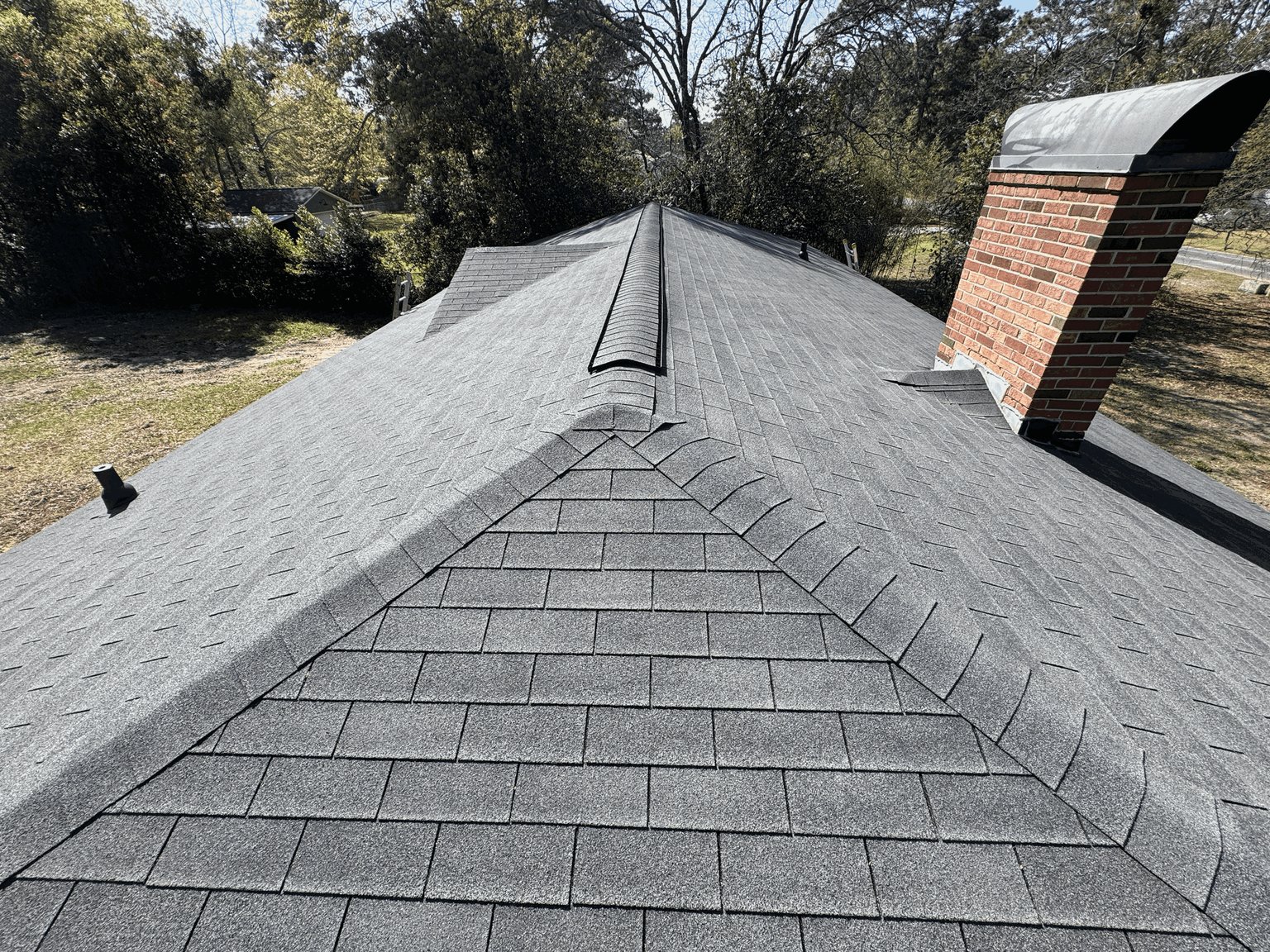
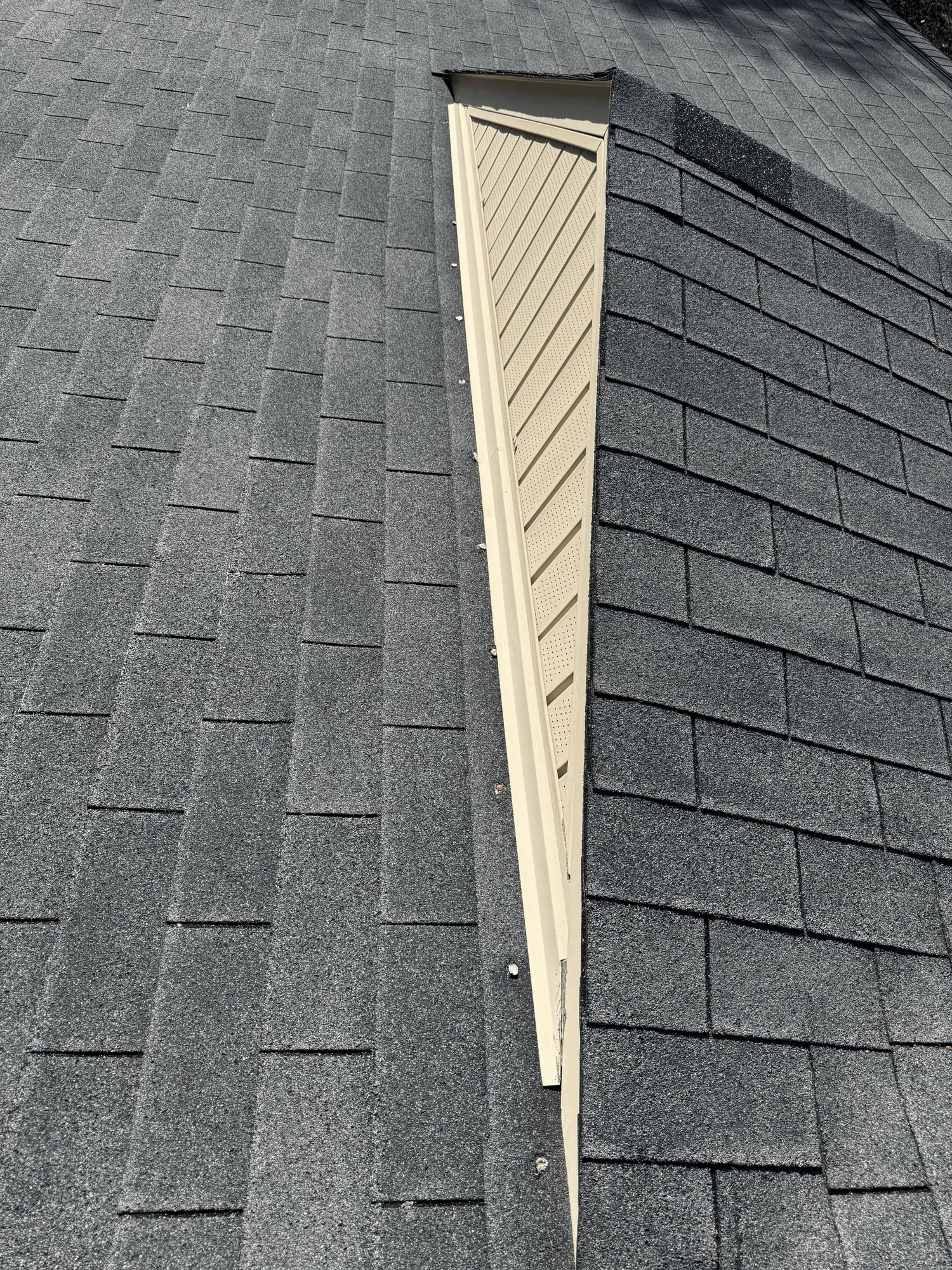
None of that is wrong. It is simply the starting point, and it ages. Our Lugoff roof replacement began with worn, dark three-tab shingles. With the shingles off, the decking around a plumbing vent had rotted through and the rafter below was soft. The new roof went on with synthetic underlayment, a ridge vent cut in along the peak, new flashing and vent boots, and IKO Cambridge architectural shingles.
To find out what you have, look for a shingle wrapper or leftover bundle in the garage or attic, check your closing or inspection papers, or look up the original permit. Our roofing materials guide shows the difference between three-tab and architectural shingles.
Signs your original roof is near the end
- Granules collecting in gutters and at downspout outlets, and dark or bare patches on the shingles.
- Tabs curling at the edges or cupping in the middle, or cracks across tabs.
- Shingles lifted, creased or missing after ordinary storms, a sign the sealant strips have let go.
- Leaks at vent boots, chimneys or walls, especially if they keep coming back after repair.
- Stains on the attic side of the deck, or a soft feel underfoot on the roof.
- Neighbors on the same street, built the same year, replacing their roofs.
One or two of these can be repaired. Several together usually mean the roof is worn out. The signs you need a new roof post has photos, and our Lugoff roof repair page covers what can be fixed without replacing.
Roof age and homeowners insurance
Insurers pay attention to roof age, and a 20-something-year-old original roof can come up at renewal, when you switch carriers, or when you file a claim. Depending on the policy, an older roof may be paid at actual cash value rather than replacement cost, or on a roof payment schedule. Our roof age and homeowners insurance guide explains how that works in South Carolina.
The practical step is to know your roof's install date and be able to prove it. If you do not have paperwork, the original permit date, the home's build date or an inspection report can help. When you replace, keep the invoice, any permit and the warranty paperwork.
Builder warranty versus roof age
A builder's warranty on workmanship is usually short, and on a house built in the 1990s or 2000s it has long since run out. The shingle manufacturer's warranty is separate and depends on the product, the terms and whether it can be transferred to a later owner. If you bought the house second-hand, assume you are on your own unless you have paperwork that says otherwise.
If your house is newer and the roof is leaking, the builder warranty may still matter. Read new home roof leak: builder warranty steps in SC for how to report it, and the roof on a new home for what to check before the first year ends.
Planning the replacement
Replacing an original builder roof is a chance to fix what was done to the minimum: balance the ventilation, put in new flashing and boots, and choose a shingle with better wind ratings. Under the South Carolina residential code, a replacement means tearing off down to the deck, which is the only way to find soft decking like we found in Lugoff. Our Lugoff roof replacement page walks through the job, permits go through Kershaw County (see the Kershaw County roof permits guide), and for cost see the roof replacement cost guide.
If your subdivision has a homeowners association, check whether it needs to approve shingle color or style first; our HOA roof approval guide explains how that usually works.
Get your Lugoff roof checked
Cola City Roofing inspects roofs across Lugoff and Kershaw County. We will tell you what is on your roof, how it is holding up and whether it needs a repair or a replacement, with photos. Contact us or call (803) 734-3700.