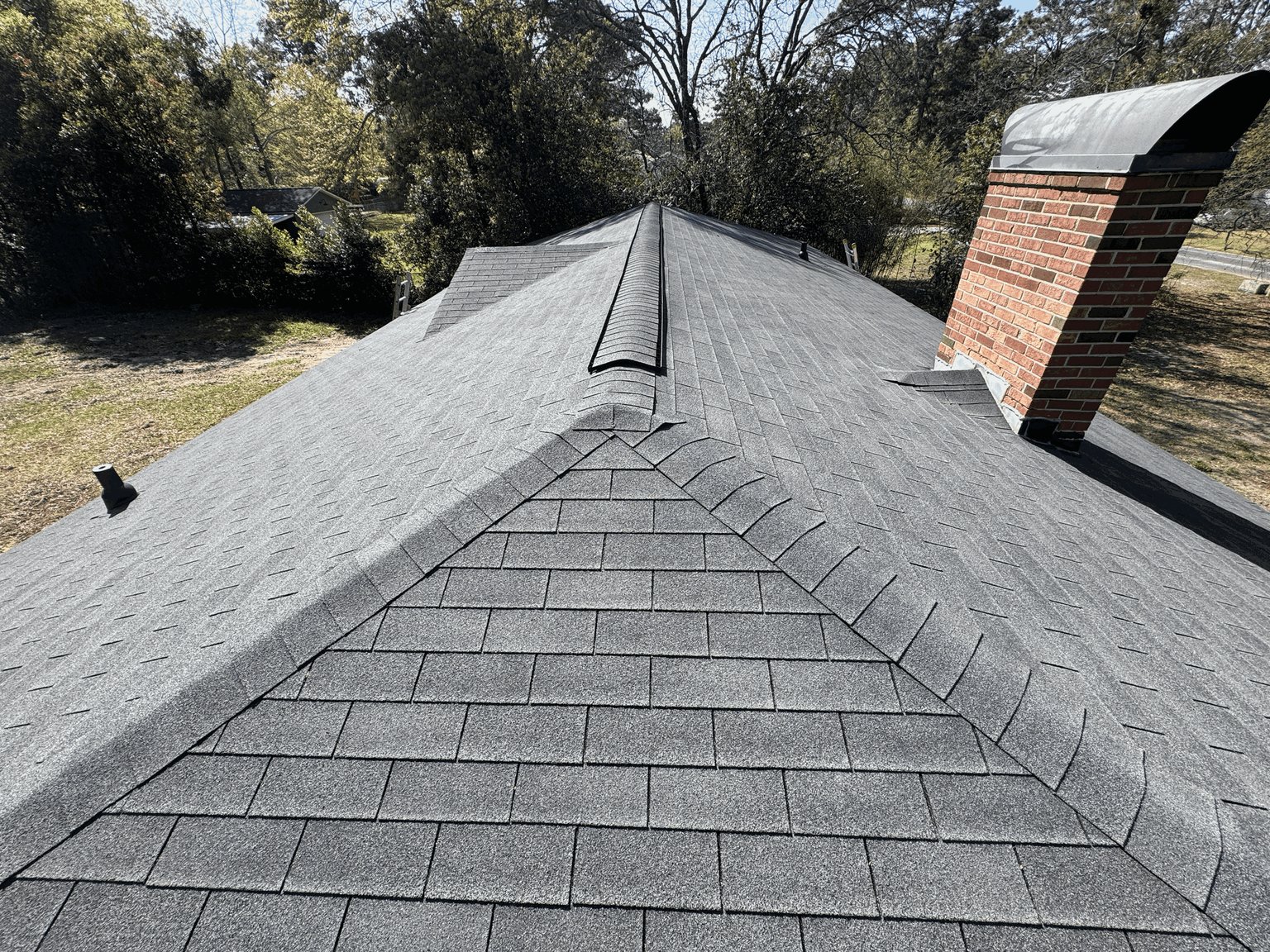
Most roof repairs in Lugoff come down to a handful of spots: where the roof meets a chimney or wall, where a pipe comes through, where two slopes meet in a valley, and where wind or a falling limb has lifted or torn shingles. With a median home built in 1995, according to Census estimates, many Lugoff roofs are old enough that these details have started to wear even when the shingles still look acceptable from the street.
This page covers where Lugoff roofs usually leak, why some patches fail, how to decide between repair and replacement, and what we look at on a repair visit. It is part of our Lugoff roofing page.
Where Lugoff roofs usually leak
Chimney and wall flashing
Flashing is the metal that turns water away where the roof meets something vertical. Step flashing is woven in with each course of shingles along a wall, and counter-flashing laps over it from the brick or siding. When it rusts, pulls loose or was never installed correctly, water runs behind the shingles. Chimneys are the most common problem because brick and mortar move and absorb water differently than the roof around them.
Plumbing vent boots
Most houses have several pipes through the roof, each sealed with a boot. Rubber collars crack in the sun and pull away from the pipe, often well before the shingles wear out. A boot leak is usually small and slow, which is exactly why it does damage: on our Lugoff roof replacement, the board decking around a plumbing vent had rotted through, and the rafter below was soft and crumbling.
Wind-lifted shingles
Shingles are held down by nails and a sealant strip. As a roof ages, the sealant can let go, and a gust can lift a tab and break it or pull nails loose. Three-tab shingles, which we found on our Lugoff job, are lighter than architectural shingles and more likely to show lifted or missing tabs after a storm. One lifted shingle can often be resealed or replaced. A slope full of them is a sign of a larger problem. See the wind damage roof guide for what to look for.
Tree and limb damage
Trees are a regular factor here: the NOAA storm record lists trees and power lines down around Lugoff in storm after storm. A limb strike can crack the deck or break a rafter without leaving a hole you can see from the ground. Branches that rub the roof in wind also wear through the granule surface. If a tree has hit your roof, start with storm and tree damage to Lugoff roofs.
Valleys and gutters
Valleys carry more water than any other part of the roof. Leaves and pine straw that pack into a valley or a full gutter can back water up under the shingle edge. Keeping valleys and gutters clear is cheap maintenance; see roof maintenance.
Why caulk patches fail: the chimney on our Lugoff job
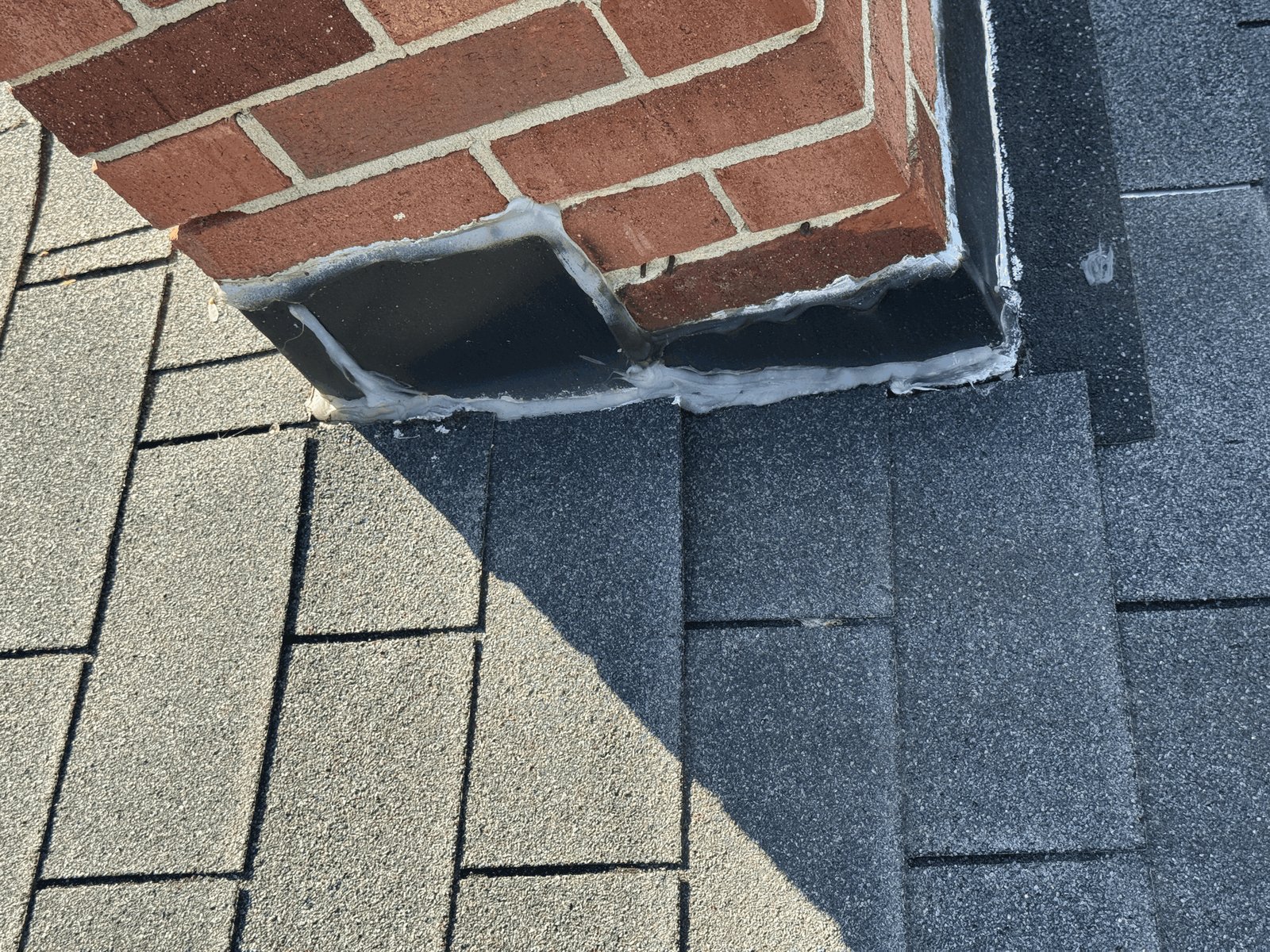
Before tear-off on our Lugoff job, the chimney flashing had been patched over and over with caulk along the brick, and the shingles beside it no longer matched. That is a common sight. Caulk is quick and cheap, and it can stop a drip for a while. It does not last because:
- Sealant shrinks, cracks and loses its grip as it bakes on a roof and the brick and metal move with temperature.
- It treats the symptom at the surface, while water often gets in higher up, behind the flashing or through the brick and mortar.
- Each new layer hides the condition underneath, so rust or rot keeps going where no one can see it.
The fix on that roof was to remove the old flashing and install new metal flashing bent to the base of the chimney and fastened down, then work the new shingles in around it. If your chimney has layers of caulk on it, ask any roofer you call how they would flash it rather than seal it. Brick and mortar repair is masonry work, so ask whether a mason is needed too.
Repair or replace?
A repair usually makes sense when:
- The shingles are in reasonable shape, with granules intact and tabs lying flat.
- The leak has a clear source, such as one cracked boot or one section of flashing.
- The deck around the leak is still solid.
Replacement starts to make more sense when:
- The shingle field is worn: heavy granule loss, curling, cracking or many lifted tabs.
- Leaks keep appearing in new places, or you have had several repairs in a short time.
- There is soft decking in more than one area.
- Your insurer is asking about the roof's age or condition; see roof age and homeowners insurance.
The repair or replace guide walks through the decision in detail. If you land on replacement, our Lugoff roof replacement page explains what that involves here.
Temporary tarping
If water is coming in and a permanent repair cannot happen right away, a tarp keeps more water out. A proper tarp extends past the damaged area and over the ridge where possible, is fastened so wind cannot get under it, and does not trap water against the roof. Do not climb onto a wet or damaged roof yourself. Keep photos and receipts, especially if insurance may be involved. A tarp is a stopgap; leaving it up for months can damage the shingles under it. If you need help now, see emergency roof repair.
What we check on a Lugoff repair visit
- The inside first: ceiling stains, the attic underside of the deck near the leak, and any damp insulation. Water runs along framing before it drips, so the stain is not always under the hole.
- Flashing at chimneys, walls, dormers and skylights, including any caulk patches.
- Every vent boot and pipe collar.
- Valleys, and gutters for granule buildup and blockage.
- Shingle condition across the slopes: lifted tabs, missing shingles, granule loss, nail pops.
- Soft spots in the deck, felt by walking the roof where it is safe to do so.
- Ventilation, since an attic that runs hot and damp ages the roof and the deck.
We photograph what we find and give you a written scope for the repair, or tell you plainly if we think the roof is past repairing. Our roof repair guide and roof inspection guide go deeper.
Permits for repairs
Lugoff is unincorporated, so roofing work there falls under Kershaw County Planning and Zoning rather than Camden or Elgin. The county's portal lists an "Exterior Renovation Permits - Roofing" type. We could not confirm from the county's published material which repairs need a permit, so ask the county at 803-425-7233, and see our Kershaw County roof permits guide for how the process works.
Get a Lugoff roof repair
Cola City Roofing repairs roofs across Lugoff and Kershaw County. Contact us or call (803) 734-3700 to set up a visit. Read more about our roof repair services.